
Slàinte mhath
My Scottish Gaelic wish to you for good health

I am a huge fan of (Scotch) whisky and love studying the history and evolution of the spirit, not just across Scotland but also closer to us in the Midwest. As the craft processes of farm distilleries shift toward automated facilities producing bottles by the millions, I am eager to look into the role of technology in this space. To give you a sample of evolution, this image from a favorite distillery below in 2012 shows a ‘bank’ of computers and monitors that then monitored production of nearly 2 million liters annually. Those “big blue” control systems below are now obsolete, replaced by an iPad as the distillery grows toward producing nearly 3.5 million liters.
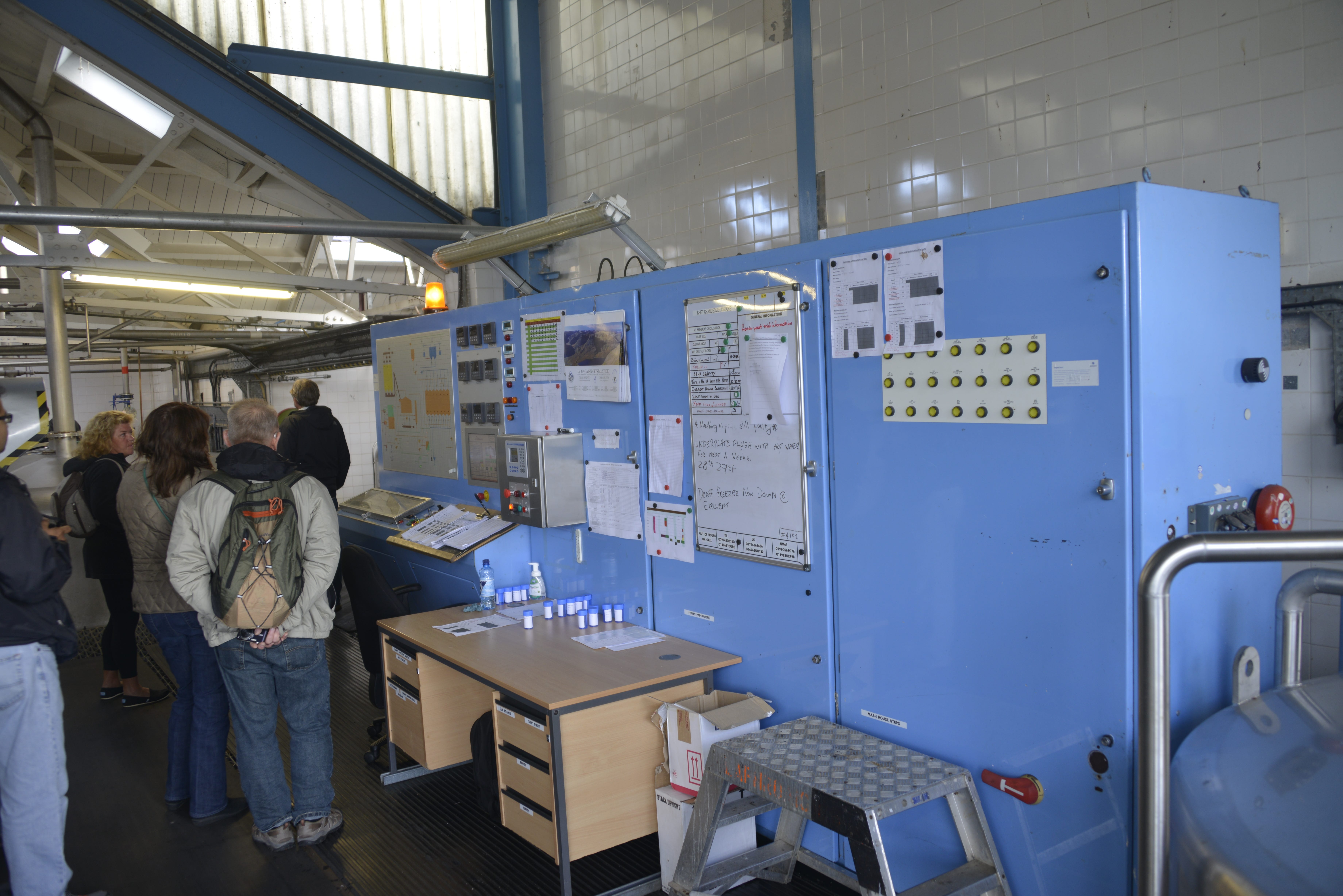
Regular readers are probably wondering why I am presenting a story about spirits, especially on a day when many are choosing to forgo something for the next forty days. Candidly, as the number of tech histories diminishes, this may serve as a transition toward stories of technologists who live a double life as creatives with other art forms. I will interview one such creative technologist later this evening (Tue, Feb 17) and will try to tell their story soon.
In the meantime, however, I welcome feedback from new readers and regulars alike.
A Couple of Hundred Years Ago
There were no iPads or minicomputers in the decades preceding Iowa’s birth. Although corn was the preferred crop for Native Americans on this land, the European immigrants brought wheat seeds and, by the 1840s, expanded wheat into Iowa’s cash crop and milled this flour for their bread. Iowa rivers also provided ready water velocity to power the mills that crushed grain into flour. Vestiges of those water-powered mills remain as historical markers in Eastern Iowa, then the hotbed of wheat and flour production. Their location was also critical as access to the might(ier) Mississippi which allowed for easy shipping.
Wayne Curtis’ book, “And a Bottle of Rum: A History of the New World in Ten Cocktails”, chronicles the midwestern states wheat production to satiate the needs of growing populations of the eastern seaboard. As immigrant and refugees to the new land increased exponentially, so did the need for more grain. Grain destined for the east had to travel by horse back across the Appalachian Mountains, an expensive and backbreaking (for the horse at least) task.
A different desire, helped along by America’s farmers, was brewing simultaneously. The enterprising Midwesterners, using any available excess in stills to distill alcohol, encouraged replacing rum with their American spirit. Realizing that they could fit far more quantity of alcohol than grain or flour, they began transporting the whisky across the plains.
The single packhorse that once moved four bushels of grain began carrying six times the grain in distilled form. The whisky was a more reliable currency, and filled the role of legal tender, medicine in form of anesthetic and sterilizer, and to neutralize the bacteria in drinking water.
Distilleries and Farming communities
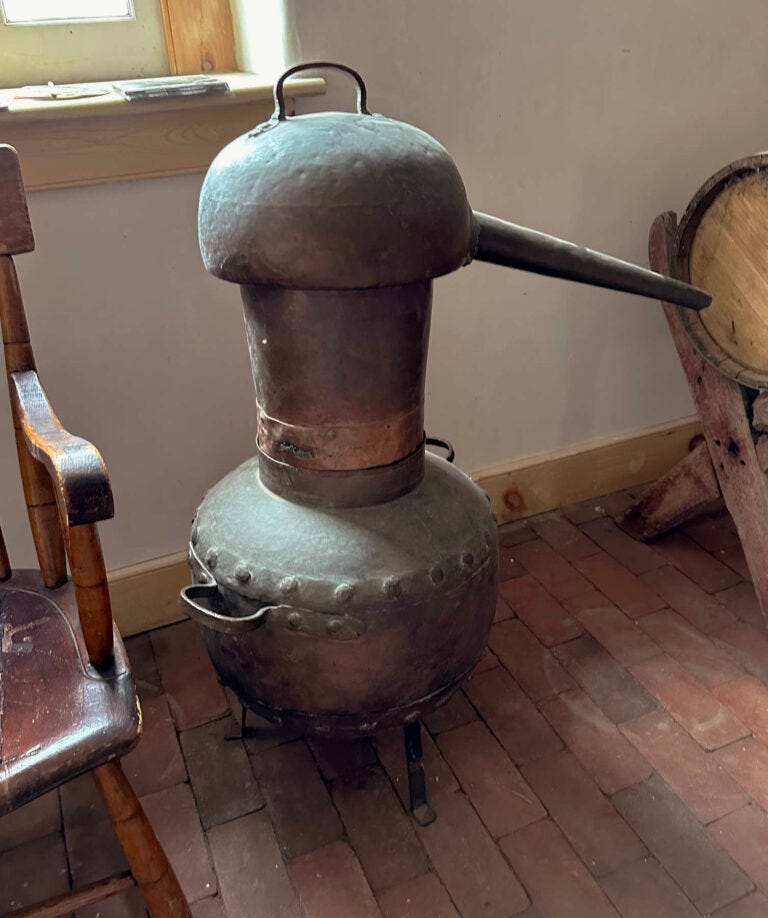
Scottish refugees, displaced by the clearances of the 18th century, brought their whisky production know-how to the United States, the Dutch brought Gin, and the Scandinavians beer. Distillation was a natural household chore on the farm and consistent with farm ethos, nothing went to waste. Excess harvest went to the still, bringing with it the unique tastes embedded in local water and soil. Some of those pot stills from the mid-1800s remain visible in antique shops and early distilleries.
I was inspired about this topic in the tiny town of Cumming, Iowa, just south of Des Moines and home to Iowa Distilling Company. The town is reinventing itself through the work of several entrepreneurs today, modernizing as an agrihood, while maintaining its decidedly agricultural identity. Two of the earliest entrepreneurs in this class might be Todd Dunkel and Phil Bubb.
The Accidental Distiller
Todd, like many others in the mid-2000s, experimented with home brewing and winemaking. Both were quite inexpensive hobbies to start requiring less than a $100 investment in equipment, easily procured raw materials, a focus on cleanliness and a healthy dose of patience. He made a batch of wine that (ahem) didn’t quite work out. (I empathize - my first attempt at making a Cabernet Sauvignon resulted in a decidedly bubbly Cab and most of the 30ish bottles went down the drain). When Todd’s failed second batch was about to meet the drain, his dad intervened and encouraged him to use the alcohol to produce brandy.
Brandy required distillation, a process unlike beer and wine that was governed by state and federal rules. Todd took advantage of recently relaxed rules for craft distillation in Iowa, applied for, and received license #004 to begin in his garage with a newly acquired still. The bag of wine was distilled into brandy, and in typical product development methodology, a minimum viable product (MVP) was at hand. His interest, however, was Bourbon, not brandy which required a little larger operation.
As you drive a mile or so east of I35 into Cumming, you encounter a stop sign with a smattering of shops, a 100ish year-old building, and the end of a bike trail. The old building on the northeast corner of the intersection was for sale. He acquired the building, applied for a bourbon permit, #888, and acquired the necessary gear. Armed with his belief that Iowa grows the best corn in the world and a love for Bourbon whose mash bill is required to contain a minimum of 51% corn, he began the process of distilling world-class whisky.
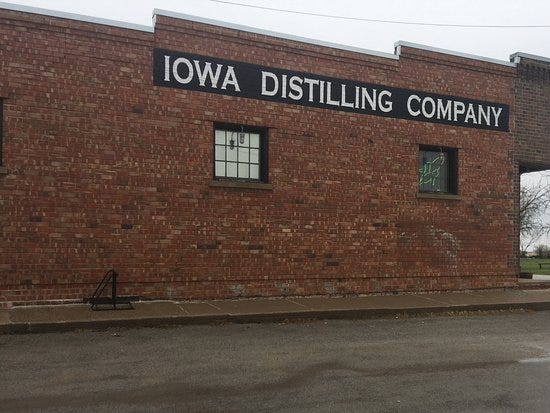
They received the licenses required to produce distilled spirits in 2010 and are now recognized with a native distilling license which affirms that their aged spirits are distilled and aged in Iowa.
From Craft to Process
Craft brewing, winemaking and distillation are an art-form. Smell, taste, visual cues and instinct play a huge part in producing the desired product. As one scales, however, a consistent taste and experience become key for the casual and experienced customer.
Art begins to invite science into the process.
For example, milled grain is one of the first steps in the process, carefully separating the husk, grits and flour (grist). A ratio of about 20/70/10 allows for balancing filtration, fermentation and starch when washed and rinsed with water in a mash tun. Measured volumes of water are applied at varying temperatures in two or more washes to extract just the right amount of starch from the flour and to allow enzymes in those starches to convert to simple sugars.
One or more water rinses optimally extract sugars from the grist and excess water retained for subsequent processes. The grist now transformed to draff also remains a viable by-product as animal feed.
Each element - the ratios, water temperature, volume, time in contact with grist, and reuse are monitored by distillers and aided with technology calibrated for individual recipes.
Yeast is added in precise measures and at optimum temperature to the sugar-water mixture and the liquid rests in a washback to let the yeast begin its work. Hygrometers, manual or automated, monitor the process, awaiting the moment fermentation is complete. Math, Physics and Chemistry may have begun the process in the mash tun, but Biology is the driver in washbacks. It is time to begin separating alcohol from the rest of the mixture in a still.
Distillation generally occurs in copper stills. Artisans who forge stills swear by the tastes imparted by the stills’ unique shapes, bends, bumps, turns, heights and lyne arms. Precision Chemistry and Physics determine when and how much alcohol vaporizes within the still as the liquid is heated, how far up the still’s neck it rises, how it is cooled and collected for aging. The tempest in the kettles is a marvel to observe in making of this spirit.
Biology reenters the picture as the alcohol from the stills is moved to barrels. The provenance of the wood governs manufacturing of the new barrels. Coopers char the barrels the inside to a precise depth (levels 1 to 5) to awaken the wood’s constituent characteristics, again specific to the recipe. The resulting char allows extraneous compounds to be filtered out of the spirit as it ages even as they lend familiar notes of vanilla, butterscotch, bananas and other fruits to the resting spirit. And finally, as angels extract their “angel’s share”, through natural evaporation, the constantly changing concentration of the spirit become the focus of the master distiller’s work.
Dude, that’s all Art - Where is the Tech?
Technology is the underlying beat in a distillery. Each step of the process is carefully calibrated to maintain quality, consistency, and repeatability. Water’s physics, sugar’s chemistry, yeast’s biology and their interplay are a carefully calibrated dance under the watchful eye, nose, taste, touch of the distiller. Slight variations in environmental temperature, volume, char, boil, weight, moisture, color and time can be disastrous or worse, explosive. Although only the most expensive and expansive factories are truly automated, millions of gallons of spirit move through craft and factory distilleries daily through a mix of modern and antiquated technology.
To the regulators, at least, the most important measure is the number of gallons bottled as spirits are taxed and controlled at the source of production, distribution, and sale. Nearly half-a-billion dollars are transacted in spirits sales in Iowa.1
Do you want to learn more?
This is the audience participation part of my request - do you want to learn more about this Iowa industry? Do you want to know what happened with Todd Dunkel and his company at the four-way stop in Cumming, Iowa? Where do native distilleries fit in our consumption pattersn? What happened to the prohibition era rye whisky that became all the rage in Iowa fifteen-ish years ago? Does Iowa whisky hold a candle to bottles from Kentucky? Can you envision a private bottling with a carefully tuned recipe (perhaps an Okoboji Writers Collaborative Spirit)?
Or was this enough of a detour and I should stick to my knitting in technology?
I am a proud member of the Okoboji Writers Collaborative, a growing eclectic collection of independent voices who share their varied interests, passions, and divergences under the watchful mentorship of Julie Gammack and a cadre of teachers and mentors. Check out their work at this link.
Great article. Slàinte mhath.
more boozy analysis! Huzzah!