
Rugged by Design
When company culture embeds itself into its products and employees

The startup ecosystem gains strength on account of its various stakeholders - from the educational institutions to government support, angels and VCs who invest early, and the corporate buyers courageous to give entrepreneurial products their first shot. Critically, however, sit entrepreneurs at the center of this ecosystem - the risk takers and dreamers who conjure ideas and set about to change the world. The most successful ones surround themselves with those who bring additive experience and expertise.
As we have seen in these pages, some of these entrepreneurs find success and addicted to the spirit of creating, continue building other ventures. Others, also as we have seen here, commit the next stages of their professional life to building the ecosystem.
Today’s story was an accidental discovery as I’d never heard of the company or founders, the product or its impact. An interview arose after a chance conversation with Curt Nelson of the EDC who told me about the company, its stellar growth and its serendipitous timing to market. This story derives from that interview and notes, company website, past news stories and a general industry direction of that time.
This story also follows a developing hypothesis that Iowans have repeatedly produced technological picks & shovels that create longevity through indispensable creations. It further leans into eastern Iowa’s regional expertise in telecommunications and introduces Crystal Group of Hiawatha to today’s readers. The same Hiawatha which was home to other past stories including Parsons Technologies and TaxAct.
The Roots of Crystal Group
The roots of the company began around 1990 when independent electrical engineer, Craig Jensen, designed an audio interface unit (AUI) that plugged into an open ISA slot on basic IBM desktop computer. In doing so, he created a cost-effective, highly scalable telephone switch. The idea was a collaborative interaction with a prior colleague, Steve Hogan, who was engaged with a regional telecom provider, Teleconnect.
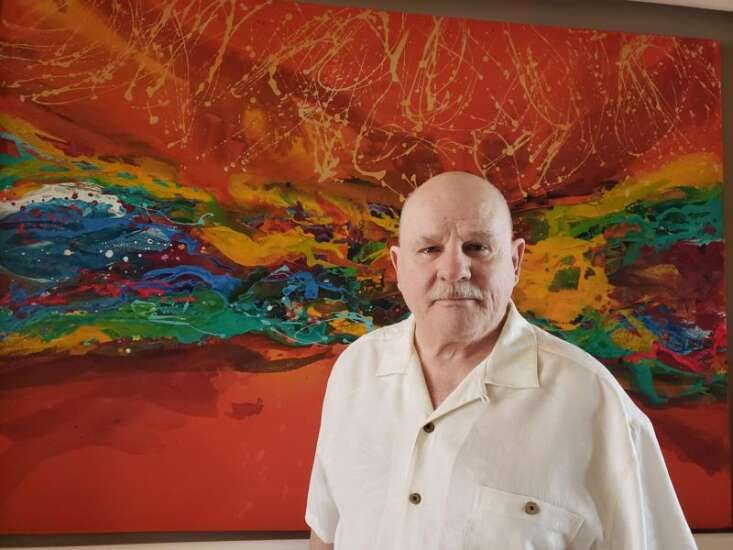
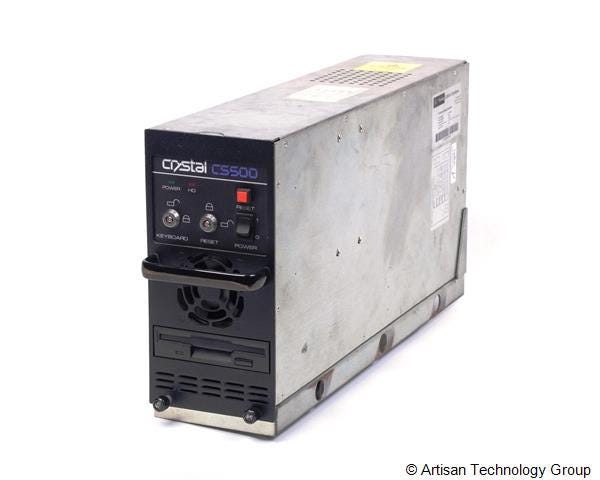
Teleconnect was sold that year to MCI, forming Telecom USA. Telecom USA provided landlines to customers and connecting further to national and international long-distance networks and was looking for a competitive edge. This AIU technology transformed scalability despite the standard desktop PCs need for physical space and their intended use in an office environment and not for rugged 24x7 operations.
Jensen stepped in and designed a smaller computer ruggedized for the 24x7 environment and crafted it for installation in central office racks, increasing density by 6x and improving operational up-time in the process.
Craig and Steve had worked together before at SignLine, an LED sign division of Nissen/Universal where Steve was Craig’s counterpart who created the code for the displays Craig designed. These displays, one 90-feet long at Ceasar’s Palace in Vegas, others on the Garden State Parkway and Phoenix Sky Harbor Airport were some of the nation’s largest and most advanced in the market. Although SignLine’s acquisition in 1985 by Trans-Lux Corporation broke up the duo, they and SignLine’s product and national sales manager, one Curt Nelson, remained in close contact.
The computer chassis produced by Craig found success as it occupied only about a sixth of the space and provided far better uptime than those of the nearest competitor. Craig formed Crystal in 1991 to build and deliver his new technology to Telecom USA and named it after his daughter, Christina.
Why Build Them in First Place
Since telecommunications hardware doesn’t always need to host standard computing components, many of these chassis are custom designed to serve specific purposes. For example, where a commercial server intended for a business environment may host a network card for two to four network connections, a telecommunications server may be designed to house a dozen telephony cards, each capable of carrying up to 48 simultaneous phone calls at full fidelity or many more at a reduced quality of service.
Just as a business server may not have once needed to host a video card for gaming support, telecommunications servers often did not need access to monitor and were operated as ‘headless servers’, devoid of any displays connected to them. Entrepreneurs, then and now, design server cases specific to their function. Their equivalence today is visible in servers, loaded with GPUs, fine-tuned for AI.
From Engineering-led to Sales-led growth
Craig built an admirable company and continued supplying Crystal servers to Telecom USA. Steve left Telecom USA to start his own entrepreneurial venture, LinkUSA, a wholesale provider of calling cards and audio conferencing (yes, kids, before free calling everywhere, customers sought cheaper ways to make long-distance phone calls or set up audio bridges for multi-party phone calls. I think I still have my bridge active from FreeConferenceCall.com).
By 1993, Craig was selling approximately $400K worth of hardware when he found reason to connect with Curt again. Craig was a great problem solver but was self-aware that he lacked the experience to scale the business. He had solid working experience with Curt and sought advice. Curt decided to listen to the voice of the customer and went where developing telcos congregated to build future strategy.
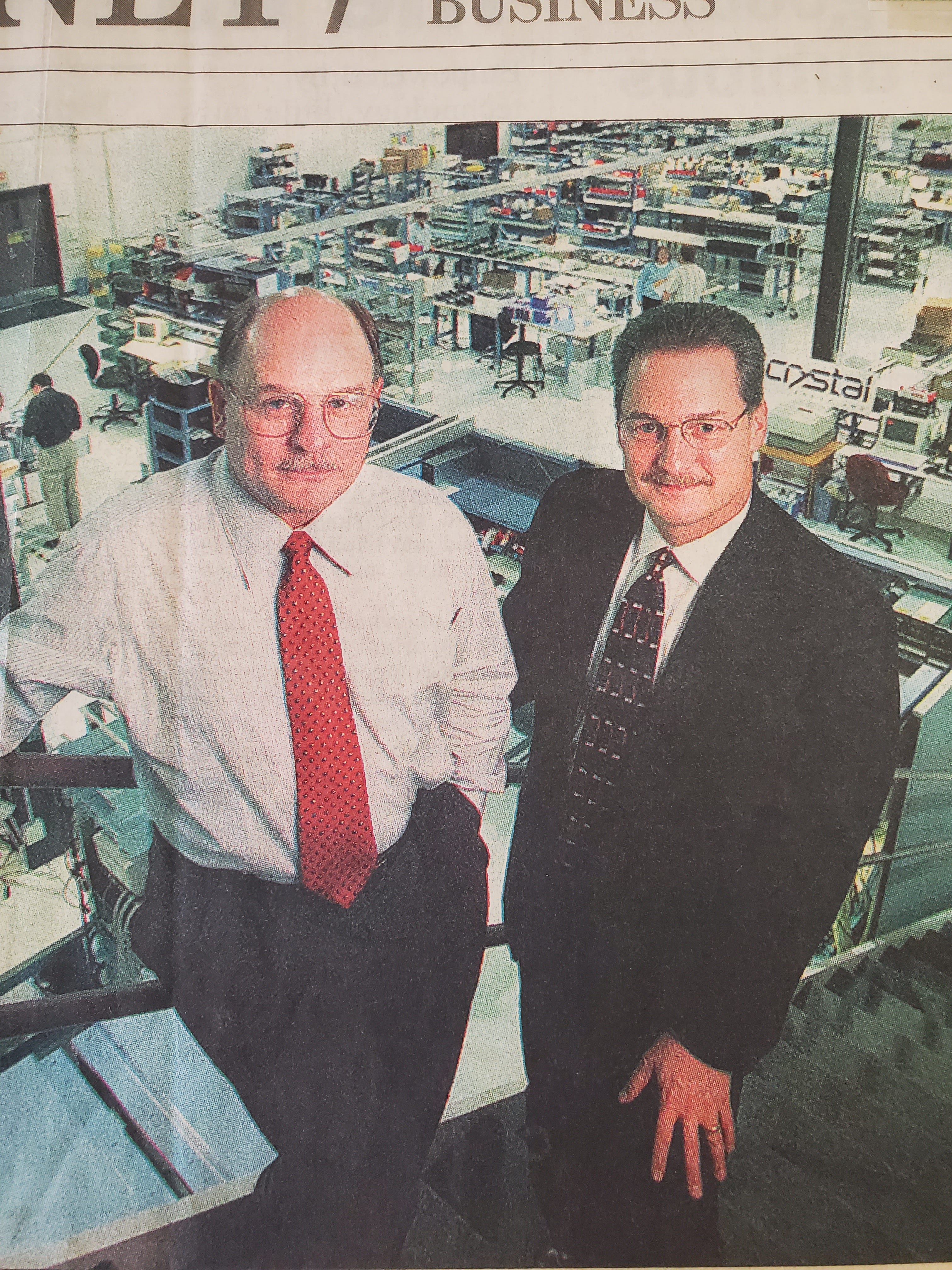
The Dallas, TX area provided this rich ecosystem. Telecom companies of various sizes, innovators and established entities provided Curt, through target focus groups, with the opportunity’s scope and size. Although Craig winced at nearly 4x projected returns from this strategy, he signed on to a $1.5M forecast for 1994. He also hired Kimberly Williams, one of Curt’s top salespeople from their prior engagement to lead sales efforts.
Engineers Build. Sales and Customer Mindset Make these Products Succeed.
As both skills are rare in a single individual, the crucial decision for any startup founder is to recognize who they are and whether they have both skills. And when one is absent, timely acquisition of the complementary skill is critical.
The sales forecast, a solid business plan, critical new members to the team and outside advisory via Curt all contributed to the company’s growth from $400K projection in 1993 to $1.6M in 1994 and their nervous audacity to set a $4M goal for 1995. Hiawatha, Iowa remained home.
As 1995 progressed toward the audacious goal, Craig and team recognized strengths and weaknesses. Although the team had managed 4x growth in the prior year, the volume of growth from 1.6M to 4M needed more overall business development experience. Craig recognized this need and convinced Curt to leave Rockwell Collins to join Crystal Group full-time. Accelerant fuel burns hotter and the company ended the year above goal at $4.2M.
The Industry Trajectory
Timing is critical for the expansion of any industry segment. The late 1990s were a period of rapid growth and investment in telecommunications. The Internet had just been unleashed out of the government and university spaces to the American consumer. The Telecommunications Act of 19961 further unlocked investment capital and nearly $500 billion was invested across the country in expanding existing lines, fiber optics, Internet over cable and much more.
The cresting wave offered the opportunity to think bigger and formulate a longer-term strategy. Looking ahead to the turn of the millennium and industry growth, the growth projections were set at $40M by 2000 - a 100x growth in seven years from a rural outpost of Hiawatha, Iowa.
Abnormally fast growth is like barreling down the highway in your truck at 70mph and changing the tires at the same time — Jim Cecil, Microsoft Corporation 1996
Microsoft Corporation offered the Fusion conference in the 1990s to its partners and resellers. At its 1996 event on their Redmond campus, Jim Cecil the self-described oldest guy at Microsoft, taught an intimate audience of ~200 of us about nurture marketing2. I sat in that room nearly thirty years ago and continue to live by his many lessons from that afternoon. Changing tires on a moving truck was one of those lessons and it came back when thinking about this chapter of Crystal’s growth.
The five-year blur
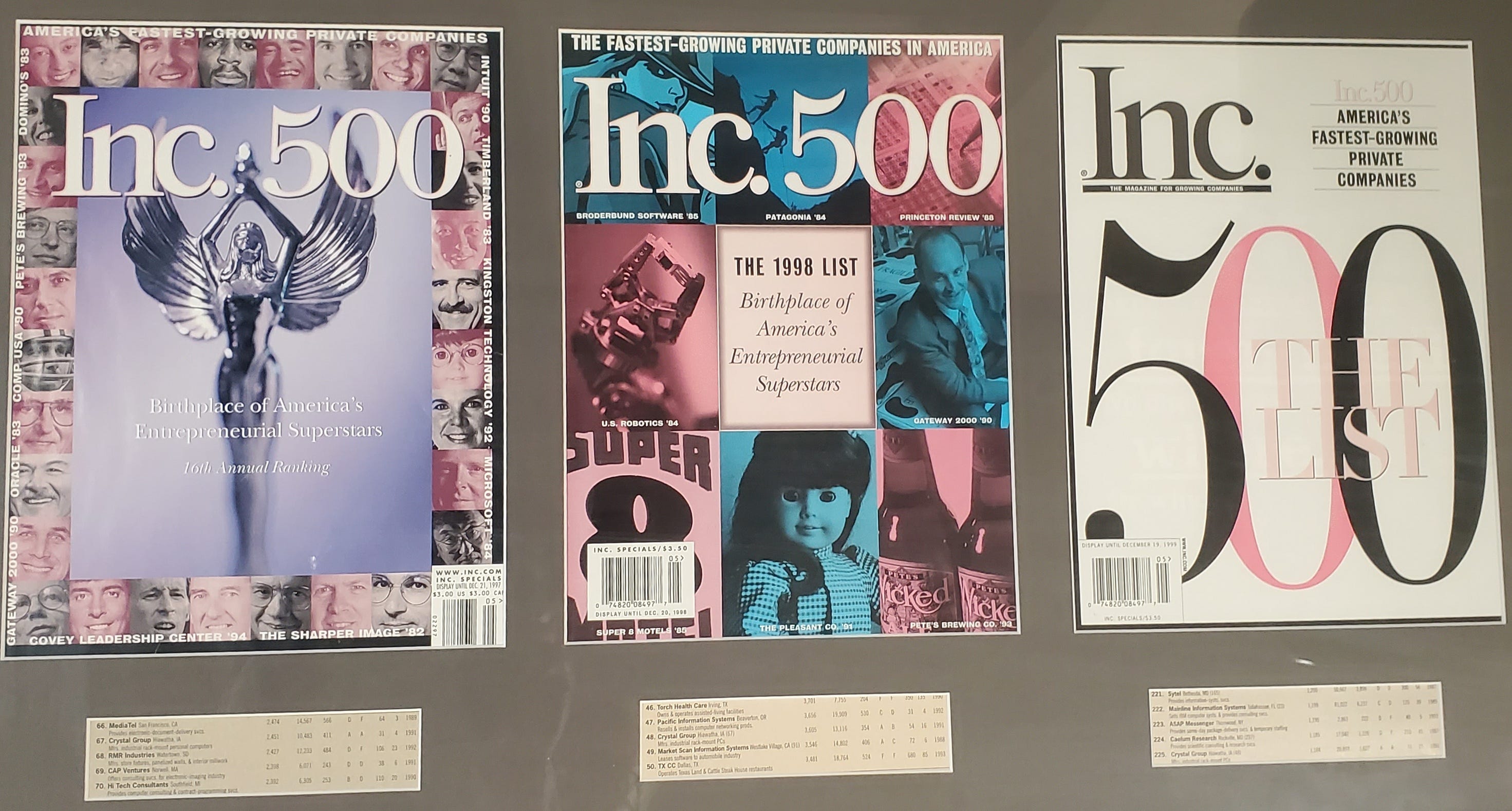
Much changed at the company in the pursuit of $40M by 2000. Revenue climbed from $4.2M in 1995, to $10.2M in 1996, $13M in 1997, $21M in 1998 and $24M in 1999. The multiplicative revenue growth caught the attention of the industry’s premier award. Inc Magazine maintains the gold standard for recognizing and award growth in the nation’s small and midsized businesses. The award, now the Inc. 5000, was then known as the Inc. 500 list of America’s Fastest Growing Companies.
The key criterion for the award was the growth multiple achieved in gross revenues over a three-year period. The near-32x multiplier earned the company spot #67 on the Inc. 500 list in 1997 - a spectacular honor with peers from Silicon Valley dominating the top of the list.
Earning a place on the Inc. 500 list is a rare achievement; securing it twice is exponentially harder. Yet in 1998, amid a crowded and competitive market, Crystal climbed to #48. A third appearance is even more elusive—few companies ever manage it. Crystal did, landing at #228 in 1999, a distinction previously achieved only by Teleconnect among Iowa-based firms.
More on the 2000 goal in a bit, but I think it is worth noting the seismic shifts across the company in these intervening years.
How do you breathe during breakneck growth?
Competent people are crucial during focused growth. Companies experiencing expansion can become tempted with growing at all costs with “warm bodies” but strategically misaligned team members can rapidly make Jim Cecil’s proverbial truck go off the road, often faster than corrective measures. Crystal continued to hire the right people and build the necessary culture to generate fast growth while delivering the highest rated customer experience in their space. Notable names from the company’s leadership include Sarah Cotty, Jane Burroughs, Jim Bladel, Deanne Montgomery, Scott Kongable and Kevin Facinelli, all complimenting each other’s skillsets and drive to win.
During this time the company built a new production and office facility, moving themselves without missing ship dates or creating quality issues. At the heart of Crystal’s success was a team of people with a common passion and determination to reach higher levels together and build a global brand in the process.
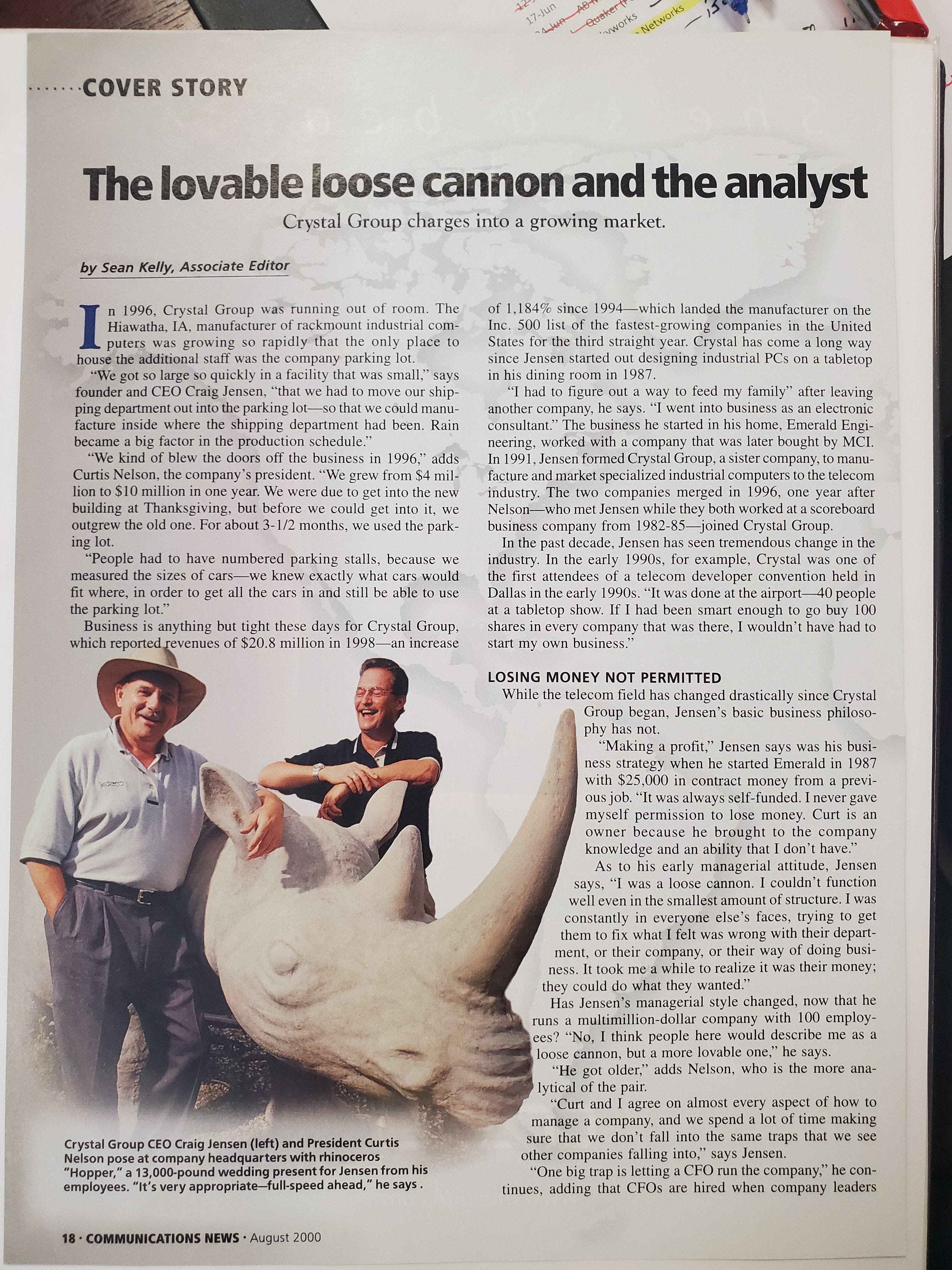
An example is a compensation program, still in use today, whereby every 30 days that the company performed without any customer facing mistakes, a cash bonus is paid to every employee equally. Missed ship date, product not working on arrival, incorrect invoice, service not completed on time were all measured. In this way, every employee impacted success in an equal manner. In the year 2000, when revenue surged by over 70%, this bonus was paid eight times; a true testimonial to the team in place.
When fast growth required production overtime, the company provided a company valet to run personal errands; allowing employees to earn overtime pay and manage family commitments at the same time.
Year 2000
The clock turned toward the new millennium without a Y2K disaster for the company heavily vested in an industry projected to experience huge failures. Prior year momentum carried the company toward its self-imposed goal of $40M which required nearly $16M growth in revenue from the prior year. They handily beat it by achieving $41.3M revenue and a 17% net operating profit. No customer facing metrics were compromised.


A win this big had to be matched with an appropriate celebration. Two G4 private jets carried the leadership team and spouses to Cabo San Lucas.
Present-Day
Although Craig has long been retired from his company, Crystal expanded in 2018 with an added 111,500 square foot facility and now occupies nearly 160,000 sq ft. in Hiawatha, Iowa. It is a major supplier to multiple industries including defense, government and industrial complexes across multiple countries. Over the years it has transformed itself into employee-stock ownership and now employes over 200 people.
Its diaspora includes Curt Nelson who transitioned into creating one of the state’s influential entrepreneurial support organizations with the EDC (Entrepreneurial Development Center) in Cedar Rapids. Since its launch, it has supported 1500+ businesses. He is a founding member of the Iowa Venture Capital Association and has added his voice and advocacy for the state’s financial support programs and investor tax credits, both administered by the IEDA.
I am grateful for the incredible Iowa Writers Collaborative community which inspires me through its teaching, curiosity, writing, poetry, songwriting, photography, and selfless service. You can experience the vastness of its expertise here.
Telecommunications Act of 1996 - Wikipedia
Nurturing Just As Important Today As It Was 25 Years Ago - Nurture Marketing
Circa late '80's: Jim McNab, radiation therapist at Mercy in DSM, realized four of his six techs had overlapping pregnancies. Long before maternity leave appeared he turned an exam room into a nursery, staffed with full-time aide, four cribs, four rockers, a fridge and disposable diapers. Gloria Wayne (daughter of John), visiting from LA to explore a partnership with Sister Pat, said she had never seen anything like it. Low-tech, but highly enabling.
Can’t believe we never heard of this! I love the cash bonus for customer service goals—aligns and challenges! Thanks for sharing.