
From passing notes to spinning their own email
the cultish allure of the Iowa company almost lost in annals of technology's history

A complex attack on some of the world’s earliest interconnected computers was discovered by Clifford Stoll in 1986. An astronomer, he was trying to avoid unemployment by working as a network administrator at the University of California Berkley computer labs. Trying to reconcile a seventy-five-cent error, he fell into a rabbit hole that would take the Berkley “hippie” into several three-letter agencies, befriend suited and uniformed officers, cross sub-Atlantic cables and measure satellite transmissions. It is near comical for today’s reader to walk through his exploration of the Internet in his 1988 book, The Cuckoo’s Egg and how he messaged his counterparts on the east coast of the United States and collaborators in Germany.
They were using email :)
Long before there was Gmail or Hotmail
Long before Gmail, Hotmail, or Yahoo (all still in-use by this Substack’s subscribers), email traffic largely traveled on proprietary email services. The user-interfaces were optimized for transmission efficiency over friendliness, even on emerging user-friendly platforms such as the Macintosh computer and its Windows and DOS counterparts. A few products experimented with desktop-based user-friendly mail applications, launching precursors to the likes of Outlook and other apps of today.
Des Moines, Iowa was relatively distant from these email developments.
Except however, for CE Software, a company that had restructured and rebranded itself from selling computer hardware (as Computer Emporium) at retail into a software company. Though the pattern of shifting from hardware sales to software products would repeat time and time again over the next two decades, Computer Emporium’s transition into CE Software may be one of the earliest instances.
Their future flagship email product was yet to be needed, discovered or born. They focused their attention to software for Macintosh computers and began working on tools and utilities that resolved everyday annoyances for the end-user.
A wonderful archive of CE Software
Although much appears to be lost about CE Software and my attempt to seek the founders for an interview failed, a single bibliographic citation led me to the Des Moines Register archives at the Des Moines Public Library. Kathy Bolten, a business writer for the Register and Gary Fandel, photographer, captured the key moments of the company’s history in the Metro Business Section on April 9, 1990, which became my primary source.


History doesn’t repeat, it rhymes
The citation, however, inadvertently led me down another path reminding me that history doesn’t repeat itself, it often rhymes. Stewart Butterfield1, the founder of photo-sharing app Flickr, once found a new career in creating a gaming company, Tiny Speck, after selling Flickr to Yahoo. Tiny Speck’s first major product, a game called Glitch launched in 2011. Though Glitch failed to gain sufficient traction, the development team’s communication platform became legend in computing circles.
The Glitch dev team kept up with each other via messages posted on internal channels on a platform they’d developed for internal communications. As they shuttered Glitch, they released this communication platform to use by outsiders. The product, a Searchable Log of All Communication and Knowledge became known as SLACK and is now a de facto communication standard.
That’s the rhyme in 2014. Back to 1981 Des Moines.
Games
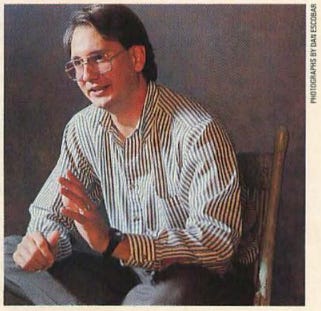
Kathy’s interview in the Des Moines Register leads us to Don Brown2 who joined the transformed West Des Moines software company as a partner. He was the brainchild behind much of the company’s software, including two games - a text-based adventure SwordThrust and Eamon, a role-playing game series. Unlike Glitch, these games found significant commercial success and were ported from Apple II to PCs, Atari computers and the Commodore 643.

As the game business delivered steady revenue and Don’s ambitions widened, the company pushed deeper into the emerging Macintosh ecosystem. What followed was a burst of experimentation: small utilities that solved real problems for early Mac users. Desktop Accessory Mover, MockWrite, MockPrinter, MockChart, and MockTerminal weren’t just products — they were proof that CE Software could spot gaps in a platform and fill them quickly. The tools eventually became bundled as MockPackage and their growing reputation drew the attention of larger publishers. One of CE’s utilities, MacDesk, never even made it to market under its own name; Borland snapped it up and rebranded it as Sidekick, a sign that the company’s instincts were resonating far beyond Iowa4.
Quickmail
As CE Software grew, so did its needs for streamlined communications. It led to the development of its most successful product over nearly two years to help internal communications. The original approach of shouting messages to each other in the early 1980s followed by the ubiquitous Post Its no longer worked for the nearly thirty person company. They looked at the commercially available software from Microsoft and Apple and found that neither worked for a company their size. Developers, being developers, decided to write their own.
The product they developed for internal use was good. Having supported the community of users across the Apple platform for multiple years, they knew they had a winning product worth commercializing. By 1989 they commercially released the first version of Quickmail. Although a utility software, another product Quickeys would remain a successful product by units shipped for some time. Quickmail, however, rose quickly in overall revenue, providing nearly half of the company’s overall $2.9M annual revenue per the April 1990 Register story.


The 1990s
Microsoft introduced Windows in 1985 in response to Apple computer’s success amongst creatives and passionate home users who loved the Apple graphics user interface. There was a widespread joke at the time that Microsoft never got anything right for at least three versions and Windows 1.0 was no exception. Windows 3.0, released at about the same time as Quickmail, however, found a footing and began making appreciable inroads into business environments. Its 1992 release of Windows 3.1 finally brought reliable networking to the desktops. CE Software added a Windows version of Quickmail to its arsenal of products in 1992, supporting a peer-to-peer messaging platform without need for a mail server, thus perfectly modeled for a small business.
Although the history behind the “why” appears lost, the company began running into delays and issues with release 2.6 of Quickmail in 1993. Though stories blame the divergent strategy of supporting Windows and Mac, alas only a conversation with the founding team could reveal the actual reason. Regardless of the reason, CE Software experienced a layoff that year, resulting in staff reductions of 7%. The 100+ person software company was back below 100.
The rapid software release cycle of the late 80s slowed considerably with version 3.0 release in 19955, and a pro version in 1997 covering Mac and multiple versions of Windows6. A version was even planned for Microsoft’s flagship server product, Windows NT even though, ominously, Microsoft’s own mail server, Exchange, was well on its way to establish corporate beachheads.
2000s
The company chose to access capital from the public markets via an initial public offering. Completed on Jul 28, 2000, CE Software began its public life on the OTC. Modern day startups don’t even consider going public without hundreds of millions in revenue. However, even in 2000, a company as small as CE Software appears to have run into filing complexities as exhibited by multiple delays in their regulatory filings within their first year as a public company7
With financial difficulties compounding over the years, significant maturation of competitive products from multiple vendors, the increasing use of Internet hosted email from Hotmail and Yahoo and growing popularity of self-hosted email on Linux servers, CE Software recognized a need to liquidate. It found a buyer in a new California company, Outspring software. The transaction was completed on the last day of 20038. Outspring Software continued to sell and support the product for nearly five additional years, finally succumbing to technological obsolescence and suspending sales in July 20089.
The company founded in 1970s as one of the region’s earliest retailers of computer products, one that successfully and presciently executed a transition to software and developed a cult-like status through software was at its unfortunate end.
Why record this story?
It is easy to capture successes with wildly profitable exits and riches distributed to owners, employees, investors, bankers, and shareholders. It is hard to revisit similar history when missteps, competitive forces, market maturity or myriad other reasons lead to a product or company’s demise. If we don’t visit this history, however, we stand to lose the lessons embedded within.
Lessons such as CE Software’s recognition that hardware sales are linear but software can be exponential. Lessons like focus (on Apple/Mac) can allow a company to excel even in uncharted waters. Lessons like distraction (Windows) can be lethal.
I am attempting to seek other failures, some occurring over decades and others in short few months or years. Such stories are hard to read and heart-wrenching to record in the entrepreneur’s voice yet must be recorded and remembered.
It is up to us, the historians and participants to remember the legacy of the entrepreneurs who went before us, to honor their work, not as a funeral for their companies but as a celebration of life - of what they achieved and how they unlocked future generations of customers, investors, employees and cheerleaders.
Stewart Butterfield - Wikipedia
Donald (Don) Brown - The Wayback Machine
MacWorld 9003 March 1990 : Free Download, Borrow, and Streaming : Internet Archive
QuickMail 3.0 - Macintosh Repository
SEC Filings by CESW - EDGAR Entity Landing Page
QuickMail Discontinued - MacTech.com
I am honored to be a member of the Iowa Writers Collaborative, a cohort of writers, photographers, poets, artists and musicians who contribute their entrepreneurship and creativity to a global audience. A visit the Iowa Writers Collaborative promises to be enriching
Thank you for the local history, and especially the list of supporting documents. More than just a narrative.
I’m old enough to remember bitnet and the use of email through universities that provided faculty with bitnet addresses. I coauthored my first book with a colleague in NJ while I was in Frankfurt Germany using bitnet. Not superfast but able to handle more than little memos.