
Creative Technologists: Improv-ing Innovation

What does telling stories of Innovation and Entrepreneurship have in common with Improv and stand-up comedy? A lot, as I found out in a conversation with Lisa Rossi of Business Publications Corporation. Lisa has the added distinction of being amongst the faculty for the Okoboji Writers and Songwriters Retreat and some of this Substack’s subscribers will recognize the name from her improv class at Okoboji just last September.
Business Record and Innovation Iowa
The Des Moines Business Record is a weekly newspaper covering businesses across the metro. An entrepreneurial venture at its core, it honors journalistic principles and rules throughout its coverage across varied mediums. Staff journalists such as Erin Crawford, Kyle Oppenhuizen, Sarah Diehn and Lisa Rossi have told numerous stories of small business owners and startups, individual innovators and major corporations, and government programs that affect statewide innovation.

Lisa Rossi, the subject of this story recently became one of the storytellers for a quartet of publications just as her predecessor, Sarah Diehn, was appointed editor of the Business Record newspaper. The quartet comprises the annual Innovation Iowa magazine, the weekly Innovation Iowa email newsletter, the annual Innovation summit, and support for the organization’s podcasts. She also contributes to the Business Record’s print publication. She covers innovation, entrepreneurship, insurance, healthcare and food insecurity.
Learning Foundations
Her recent journeys cover such varied topics as understanding the role of AI during an appointment with a physician. She needed to understand the changing landscape of medical interactions, privacy, information security, speech-to-text transcriptions, electronic health records, employee burnout, insurance and more. Understanding the diverse (and divergent) viewpoints, distilling them into a relatable story for her audience, and publishing the story for varied requirements by the quartet of publications required her to dig deep into more the widely divergent background matter.
Another story crisscrossed the changing role of a CIO which was once singularly a technology leadership position. As she reported on Sanjeev Satturu, CIO of Caseys in Ankeny, IA, she learned about the CIO’s shift from technology leadership. She learned how the technology role has shifted toward a critical executive with wide-ranging responsibilities covering human resources, policy, financial oversight, vendor management, innovation, digital transformation, marketing and communications.
Another example covered a topic on top of mind for many Iowans - data centers, water use, and energy. Here she needed to learn and understand data center operations, why and how water is utilized, its impact on aquifers and fragile ecosystems, hyperscalers, hosted data centers where multiple clients lease data center spaces, data center operators’ sustainability programs, energy generation, usage, and pricing, and renewable energy programs.
These required more than a cursory understand of the various technologies listed and required her to listen and learn from her readers’ perspective, a skill learned in school, honed at the Des Moines Register, and connected to an undiscovered interest later at Stanford University.
Early Career
Lisa grew up in rural Iowa, in the small town of Dike near Waterloo and Cedar Falls. A bachelor’s degree in political science with a minor in journalism and internships at various newspapers including the Des Moines Register, The (Cedar Rapids) Gazette, and the St. Louis Post-Dispatch ultimately brought her to the role of reporter at the Des Moines Register in 2003. She continued to hone her skill and move through storied magazines and journals, including an associate regional editorial role at Patch.com.
Those roles prepared her for a unique role for a journalist at the Des Moines Register, a newspaper she rejoined in 2015 as a storytelling coach. She helped the team turn reportable content into stories that improved engagement just as the newspaper began measuring, improving, and monetizing on its new digital platforms.
To further her interest in studying leadership, she enrolled in a workshop on the subject in Philadelphia where she met a colleague who recommended a fellowship at Stanford University. She learned more about the program, found it intriguing, and poured her heart into the application. She was accepted and she left the Des Moines Register position behind to begin the challenging fellowship in the heart of Silicon Valley - Palo Alto, CA.


Intersections
Stanford is a melting pot of personality traits. As one of the premier educational institutions with proximity to Silicon Valley, it attracts significant numbers of creatives and extroverts. Stanford’s program at John S. Knight Journalism Fellowship encouraged journalism leaders to develop themselves beyond storytelling and Lisa gravitated toward design thinking and the innovation process. She learned the technique of asking questions, discovering the problem, developing prototypes, testing, iterating, re-testing until the true solution to the underlying problem revealed itself.
As she armed herself with these new skills and presented her work to live audiences, feedback encouraged her to improve her presentation through improv. Improv, the skill of discovering and exploring conversation by deeply listening, making mistakes, responding to situations live on stage was new to Lisa but helped break down her self-preserving walls that inhibit complete discovery. Improv, it appears, was a favorite of startup founders and entrepreneurs who loved the process of iteration, improvement, show, and audience delight.
The new discipline was about to change her in new ways.
Bonfire
Upon graduating from the program, Lisa decided entrepreneurship was in the next desired career move. She launched her company, Bonfire, to help others deploy design thinking in their problem-solving work. Modeled after the backyard bonfires of her childhood, Bonfire brought together people to share ideas, problems, thinking and solutions. She collaborated with Chris Snider, a faculty member from Drake and others who knew principles of design thinking and were seeking a community of practice in Des Moines.
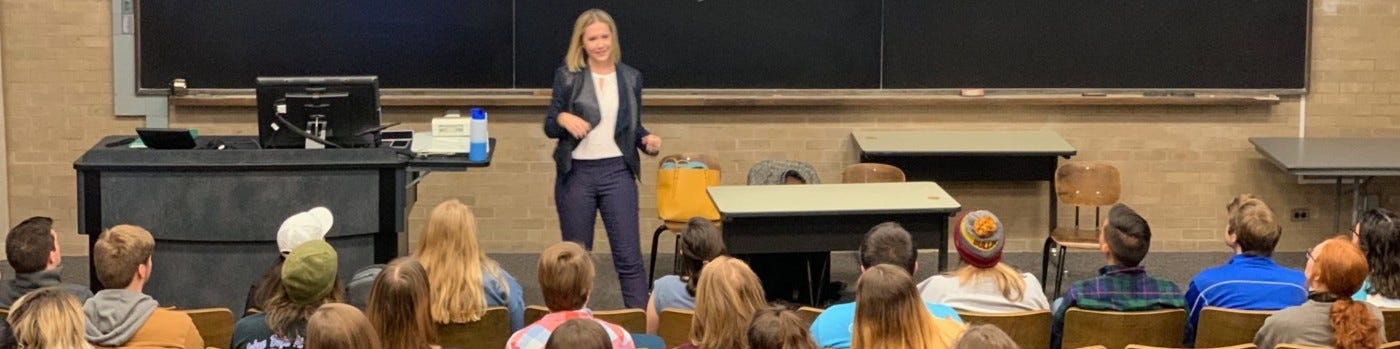
The community of practice grew just as new threat appeared over the horizon, a global pandemic. A group, inherently designed to foster collaborative work through proximity suddenly became the casualty of social distancing.
A journal-keeper at heart since her childhood, Lisa kept anecdotes, stories, and nuanced conversations close throughout these experiences, unknowingly building a body of work about to charge a different new endeavor.
Although Bonfire LLC was dissolved, her second company, Lisa Rossi Comedy LLC continued to develop material in the background.
Open Mic Nights
The passion for Improv ignited during her fellowship at Stanford led her to open mic nights across Des Moines. In contrast with the slow-simmer ideas traditionally receive in the Midwest, she had absorbed the fast-paced and iterative innovation habit on the west coast. She had honed other design thinking skills through Bonfire and leaned into the compendium of stories collected through conversations.


She began testing her material in 5-minute comedic routines. She kept record of what worked with the audiences and what did not. And just like her journalism of the past decade, she listened and told stories. The lessons she shared for jokes apply remarkably well to innovation and entrepreneurship:
You’ve got to subtract
You’ve got to let things go
You’ve got to let bad jokes go
You’ve got to let bad ideas go
You’ve got to let bad stories go
She brings continuous editing and honing to her stories of innovation and gravitates toward entrepreneurs who are doing just that. She tells the story of Zack Smith who created his company Stock Cropper to re-intersect livestock and crops working together in a closed loop, low carbon intensive, synergistic field arrangement. Finding that it didn’t appear to solve a customer need, he found success after quickly pivoting his technology toward people invested in chicken husbandry.
Improv’s lesson in entrepreneurship
The Improv practice coaches participants to discover ways to win the interaction, yet audiences tend to connect more with the appearance of loss on stage. The vulnerability demonstrated through learning and participation engages audiences and leaves them talking. Although talking about a failed business is far from humorous, improv’s lessons of letting oneself lose an argument, position, or opinion can be freeing to discover what’s next. Plunging into the uncomfortable space of not knowing what is next and choosing to discover can be exhilarating.
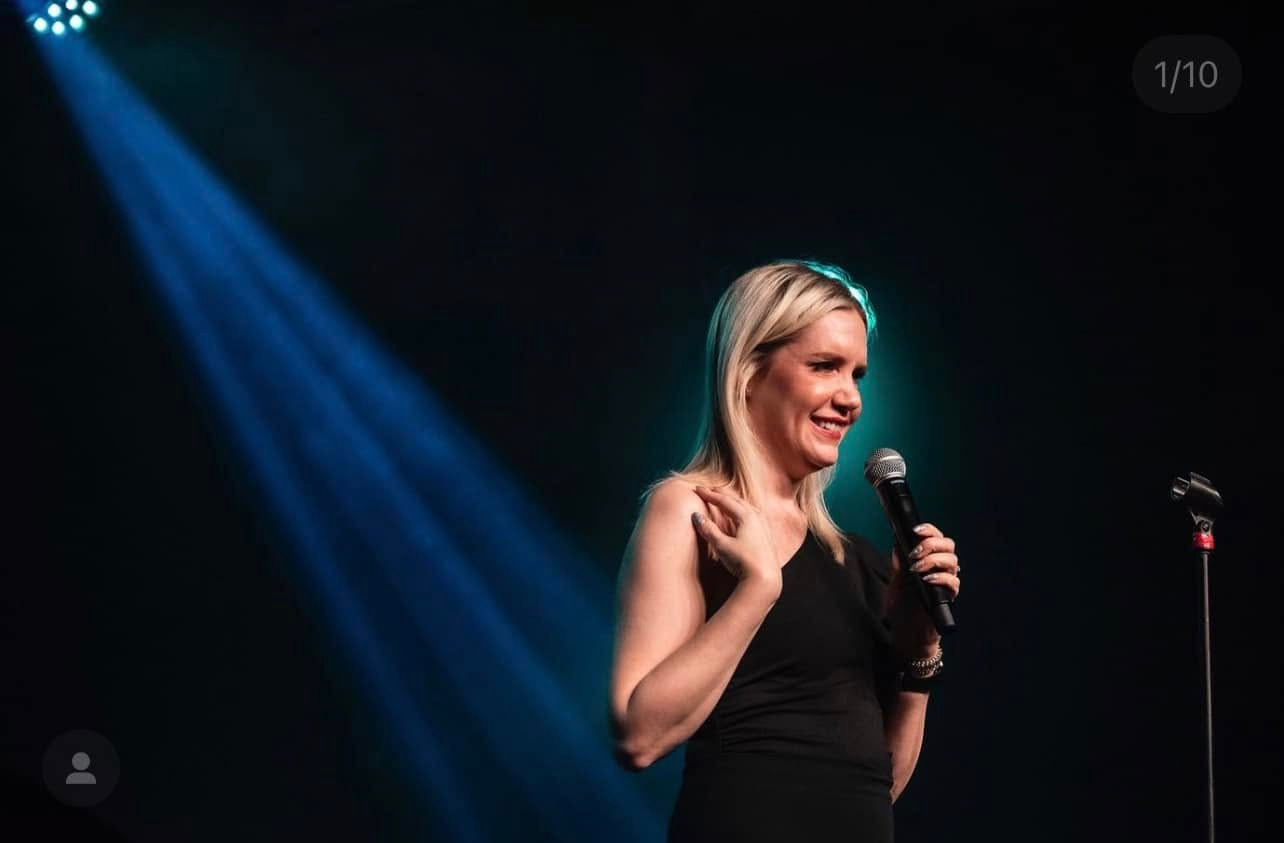
Lisa begins her stories for the Business Record with such ambiguity. Choosing to begin with being ignorant, she humbles herself with sources and materials and begins to learn anew. Her goal is to know more about the topic than will ever enter her published story, to write with her reader in her view, and whose response to reading her stories is generally a ‘wow, I had no idea’.
What’s next?
Rooted in the discipline of meticulous journaling, improv’s continuous unpeeling of an onion, a penchant for comedy, and a wealth of scenarios collected from varied life experiences, Lisa is now learning the art of writing a mystery novel. She is learning about the genre by reading voraciously, learning the form and structure of mystery storytelling. The busy mom of teenage boys appears to have found the perfect time to learn - in a cabin by a lake as her boys fish for the family’s dinner.
Why I think these stories are important?
Creative individuals live and work across the state, in rural communities, suburbia and urban centers. They are writers, poets, singers, musicians, photographers, YouTubers, authors, speakers, podcasters and so much more. The Internet has given them the world as a potential market, and many are creating their own versions of the Silk Road. The Okoboji Writers and Songwriters Retreat is one such venue where creatives assemble to share, expand, and hone their craft.
Most are independent, individual, and creative in their special spaces - be it a comfortable nook, an intimate stage, a pottery studio or even a car on the open road. They may not be building IPO-ready businesses yet are creating a life and livelihood unique to their need, passion, and initiative.
These past 5 stories have taught me a great deal, and I look forward to discovering others. In the meantime, however, I intend to return next with another big bang Iowa invention that remains virtually unknown outside select circles.
One of the things I've always respected about people with journalism backgrounds is their ability to take on a new "beat."
There are a lot of parallels with management and leadership: You don't have to be the expert of the (new) beat but you do need to know how to talk to experts and be curious.