
The Binary Star Ecosystem Dilemma
Iowa is 1% of the U.S. population and US is 4% of the global population. That’s 1% of 4% of the world. If we don’t act together, we risk becoming 0% of relevance.

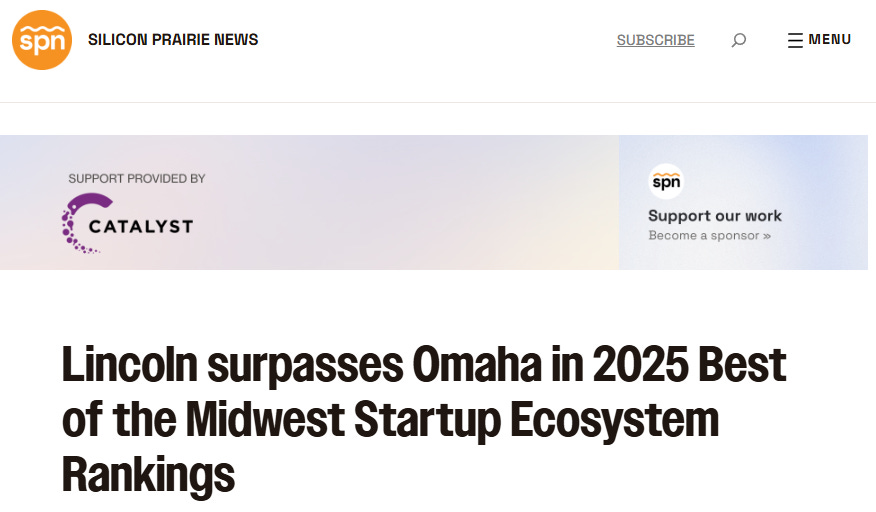
This post takes a slightly different path than recent stories. It is inspired by one of my Nebraskan friends, Tom Chapman. Tom is a fellow startup builder whose recent post on LinkedIn has touched a nerve, likely instigated by a ‘best ecosystems’ report by Chicago-based venture firm, M25. His opening paragraph says it near perfectly:
Omaha and Lincoln need to come up with better branding. I maintain that Omaha and Lincoln are the same startup ecosystem. Just as my neighborhood is different from Aksarben or Dundee or the Haymarket - they make up components of a larger whole.
Before raising your eyebrows at Omaha and Lincoln not being Iowa cities AND this Substack’s focus on Iowa, please allow me to steal the next few minutes from your day.
Across the Missouri River
Tom urges the twin cities of Lincoln and Omaha, separated by a mere 45-minute drive, to think bigger. Rather than see Lincoln celebrate its lead over Omaha by a 1.4 point, he urges the region to call and look at itself cohesively as one, no different than its business community of attorneys, startups, and athletes who don’t bother about the artificial boundary.
He leaves his urging shy of a rant by simply asking the Lincoln and Omaha communities to see and rebrand themselves as one with a name better than he could conjure up. A name better than Silicon Prairie reminiscent of the decade past when everyone wanted to be the alternate Silicon Valley despite having NONE of the valley’s strengths or advantages. (Before readers familiar with my background roll their eyes further into their sockets, I too am guilty of gleefully participating in the temporary rechristening of three blocks spanning 6th Avenue between Mulberry and Grand as Silicon Sixth Ave in Des Moines).
The zero-sum game of economic development incentives urges one to win against the other while losing sight of the missed larger opportunities for the underlying communities. I suspect the following “win” and story will be quoted ad nauseum to nobody’s long-term advantage.
What are Startup Ecosystems?
Massachusetts Institute of Technology (MIT) hosts a program for accelerating entrepreneurship in various regions of the world (REAP). It defines startup ecosystems as a group of stakeholders from Government, Universities, Corporates, Risk Capital and Entrepreneurs who co-create strategies tailored to their unique context.
I am a member of a 12-person cohort that participated in this program from 2021-23 and continues to be driven by the lessons learned. As program participants, we were joined by teams from Omaha, Kansas City, St. Louis, Hungary, Dominican Republic, Western Australia and the state of Piaui, Brazil. Most teams differed from each other, but teams from two regions were eerily similar — Nebraska and Iowa. Our work was generously supported by the Kaufmann Foundation who saw the four Midwest teams as a singular region - the heartland.
Early in the program, MIT shared a lesson about how regions bring unique strengths generally unaffected by city, county, state, university affiliation, or benefactor-driven borders. They walked us through how Silicon Valley leveraged and reinvested in its technology strength over decades. We learned about the decades during which Boston area’s Route 128 lost its technological lead only to nurture and reinvent itself into the Life Sciences corridor. Meanwhile, New York leaned into its financial institutions and became the financial ecosystem.
Despite sharing this lesson with us, the faculty recognized the current AI revolution underway and that they didn’t want to lose their technological lead once again to Silicon Valley. They were building their own edition of the ecosystem surrounded by AI research across medical, law, biology, amongst other domains. Three years since that lecture, sadly, it is clearly lost to Silicon Valley and China. I might argue that recent actions may erode the life sciences lead as well as Moderna and Broad Institute that exist mere blocks from the MIT classrooms are subject to present-day politics. Ecosystems are a fragile bunch.
What made Teams Omaha and Des Moines similar?
The two teams attended our first session on MIT’s campus in Cambridge and stayed at a hotel in Boston. We happened to run into each other in the hotel lobby the first morning of the program in 2021, greeted each other as old friends, and were already familiar as we walked into the program’s start.
We were similar in being two of the most well-rounded teams. We were diverse across geographic, ethnic, experience, gender, and age spectra. Each team had members who’d been involved in their startup ecosystems for over a decade. And some who were brand new. Many knew each other from across state lines. They represented each of the five stakeholder groups. No one seemed territorial.
How were we different?
Massively!
The credit for the biggest difference belongs squarely to Diana Wright. As team sponsor and curator of its members, she began with the thesis that the Des Moines region didn’t stand on its own without Ames completing the binary star system. ISU academics, ISU Research Park, and Ames-based entrepreneurs and risk capital team members complemented Des Moines-based entrepreneurs, risk capital, government and corporate team members.
Diana called us Team Central Iowa despite MIT referring to us as Team Des Moines.
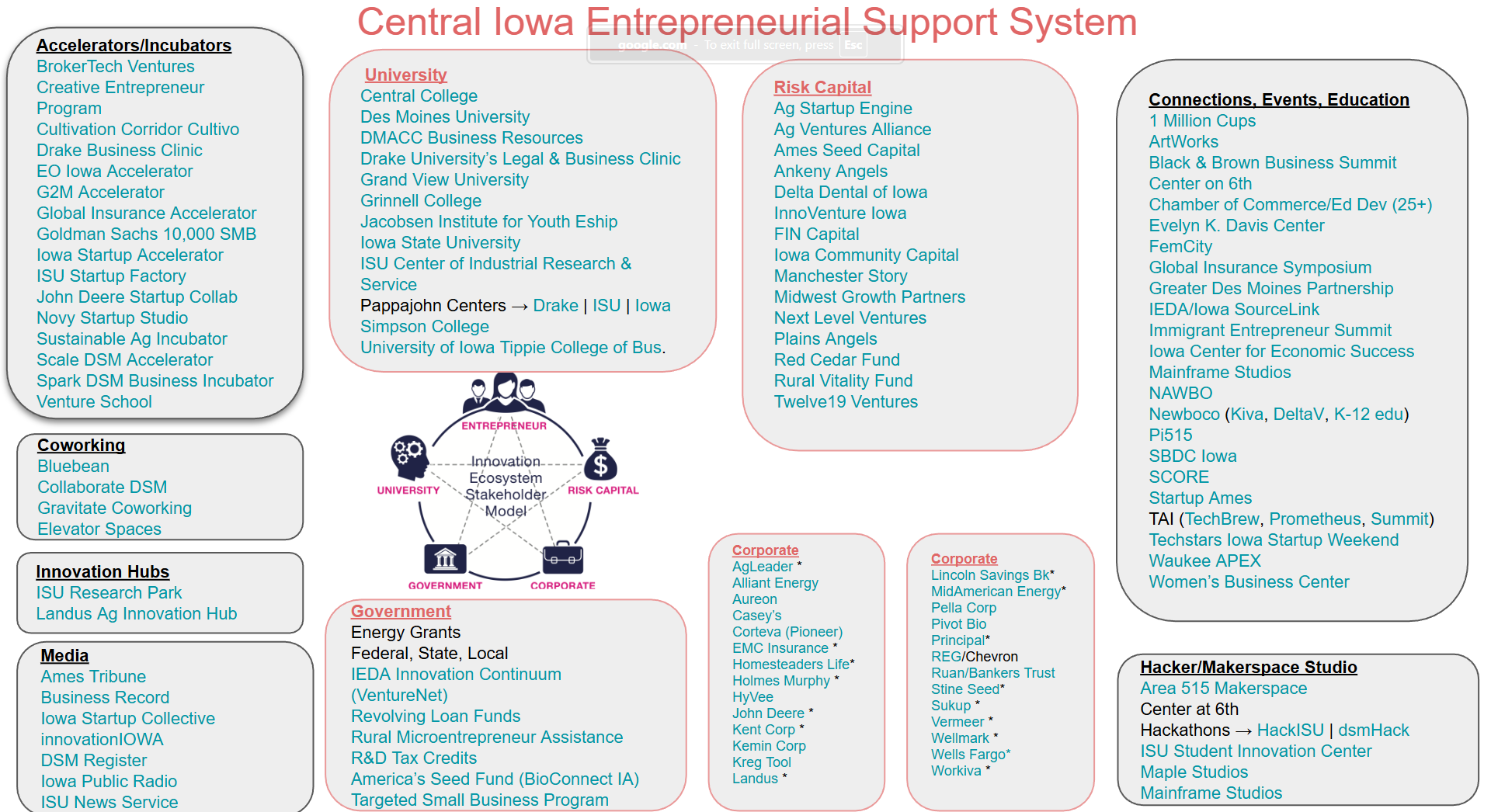
Our first homework assignment produced a utopian (and impressive) curation of resources available to entrepreneurs across Iowa.
The aftermath
We graduated with a degree from MIT in December 2023. Although that in and of itself would be impressive, I am most impressed with what came after. Making the joint decision to simply continue our work and effort voluntarily, we wanted to make the Central Iowa entrepreneurial ecosystem stronger.
We called the post-graduation team the ESHIP Coalition.
We found willing friends along the way - Sarah Diehn, editor of the Business Record, dug in and dedicated an entire issue of her company’s Innovation Iowa magazine to the work of ecosystem building and the new coalition. New members from the Technology Association of Iowa, Iowa Area Development Group, EMC Insurance, Next Level Ventures, and more have leaned-in and shared their talent just as some have had to take a step back and dedicate their time back to their own enterprises. A few invitees clearly opted out of participating. The work continued.
My Substack and those from the Iowa Startup Collective are one of the coalition’s products.
Tom Chapman’s spark
Tom has reignited the priority to have a meaningful name for the region that speaks to its cohesion. Though he (jokingly) suggests BuilderPlains and Platte Region as names, he realizes a better name is out there brewing in minds of fellow creatives. I think we have a similar opportunity.
Ames and Des Moines orbit each other like binary stars-distinct yet gravitationally bound. Separately, they are two cities 30 miles apart amidst acres of farmland. Together, they are as intertwined as the north to south highways threaded through them. Just like Lincoln is separated by a six-lane highway from Omaha, Ames and Des Moines are close to achieving a similar high-speed corridor. But, it will take more than asphalt to make the two dance as one.
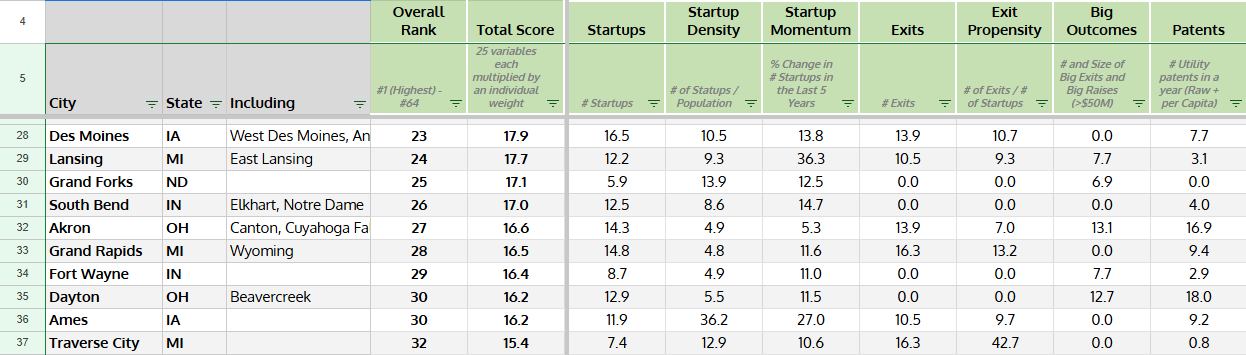
Patents are filed at research institutions and must be commercialized. ISU, a research university unsurprisingly scores better in patents/year. Des Moines metro area, on the other hand, has a larger population density than Ames with potentially a larger workforce. Ames has a more educated workforce while Des Moines region has a larger number of big companies and venture capital. Like Omaha and Lincoln, they have strengths to individually win headlines. TOGETHER, however, the region has power to create headlines.
You can see the graphical macro view but I invite you to dig into the spreadsheet.
As we think about our size (Iowa is 1% of the US which is 4% of the world), can we really afford to alienate the two other Regents universities, the superbly resilient entrepreneurial ecosystem in Cedar Rapids, the massive investments by Iowa City, and the talent developing in our liberal arts colleges throughout the state?
It is demoralizing to experience the us vs. them in our tiny community. Should a downtown move by a suburban company be celebrated as a win for the former and mourned by the latter? Silicon Valley builds global empires while we count counties.
Should members of the metro area duplicate what another is doing well, thereby reducing the overall impact on the region? Zero-sum games waste meager resources and compromise chances of success.
Ecosystem builders have a responsibility to help make the region attractive to companies. And if a member of the ecosystem has a chance to find greater success OUTSIDE their ecosystem, we should stop at nothing to help them be where they can be the MOST successful - Omaha, Minneapolis, San Francisco, or Munich. Companies should be encouraged to go where they will grow the most so they can return (home) to a place they love and that helped them be successful.
The word ecosystem has its roots (pun intended) in Biology. Ecosystems grow through diversity and collaboration. Its tallest trees are supported by an unexpectedly strong underground network of invisible mycelium, the root like structure of fungi. Members are born and perish with time. Some suffocate under plenty, as others starve for resources. All need to be nurtured and pruned. However, if all of its strongest producers are in a single part of the ecosystem, the slightest threat can obliterate all.
Occasionally, some have to be transplanted.
Is it time to rethink our approach?
Yes. A singular entity isn’t at two ends of a corridor. It is one in name, spirit, support, and systems. Tom identified this need for Omaha and Lincoln. I think Kansas City and St. Louis are even further apart than our northern regions, but will recognize a similar need one day. The Ames-Des Moines region recognized it, created organizations to define a strategy, named it the Cultivation Corridor once before, but still have a long way to become one.
The right name won’t save us. But it might just unite us.
I am a proud member of the Iowa Writers Collaborative, journalists, poets, authors, and artists supported by a passionate community of readers.
Love this. An ecosystem is NOT a city, and the evidence that most of the startup community is confused is we keep letting them compare city to "Silicon Valley" and then pretend a city is sufficiently similar with a coworking space, an accelerator, and Silicon in the name.
The comparison of Iowa with nebraska is a good one and informative. Fragmented efforts do not ever allow the scale that larger, coordinated efforts can achieve. But people love their little fiefdoms. History shows how those crumble and consolidate unless these is a unique and powerful value proposition. Great insight!