
The 54-hour marathon

I am taking a detour and telling a different story today. It explores the psyche of the entrepreneur, revealed through a gathering that’s became a global phenomenon with a Des Moines connection.
First, a thanks to Ramco Innovations and Maple Studios and the ever-effervescent Megan Brandt for hosting the event. It takes a lot to open up an office to dozens of strangers and we are grateful.
Butterflies
Imagine walking into an unfamiliar modern garage with polished concrete floors, the gray millennial aesthetic, people of all ages milling about, and a latent indescribable energy. You are amongst the dozens answering the call to come build a business together over 54 hours in this space yet know virtually no one (yet); your only connection to the others via an electronic confirmation of attendance.
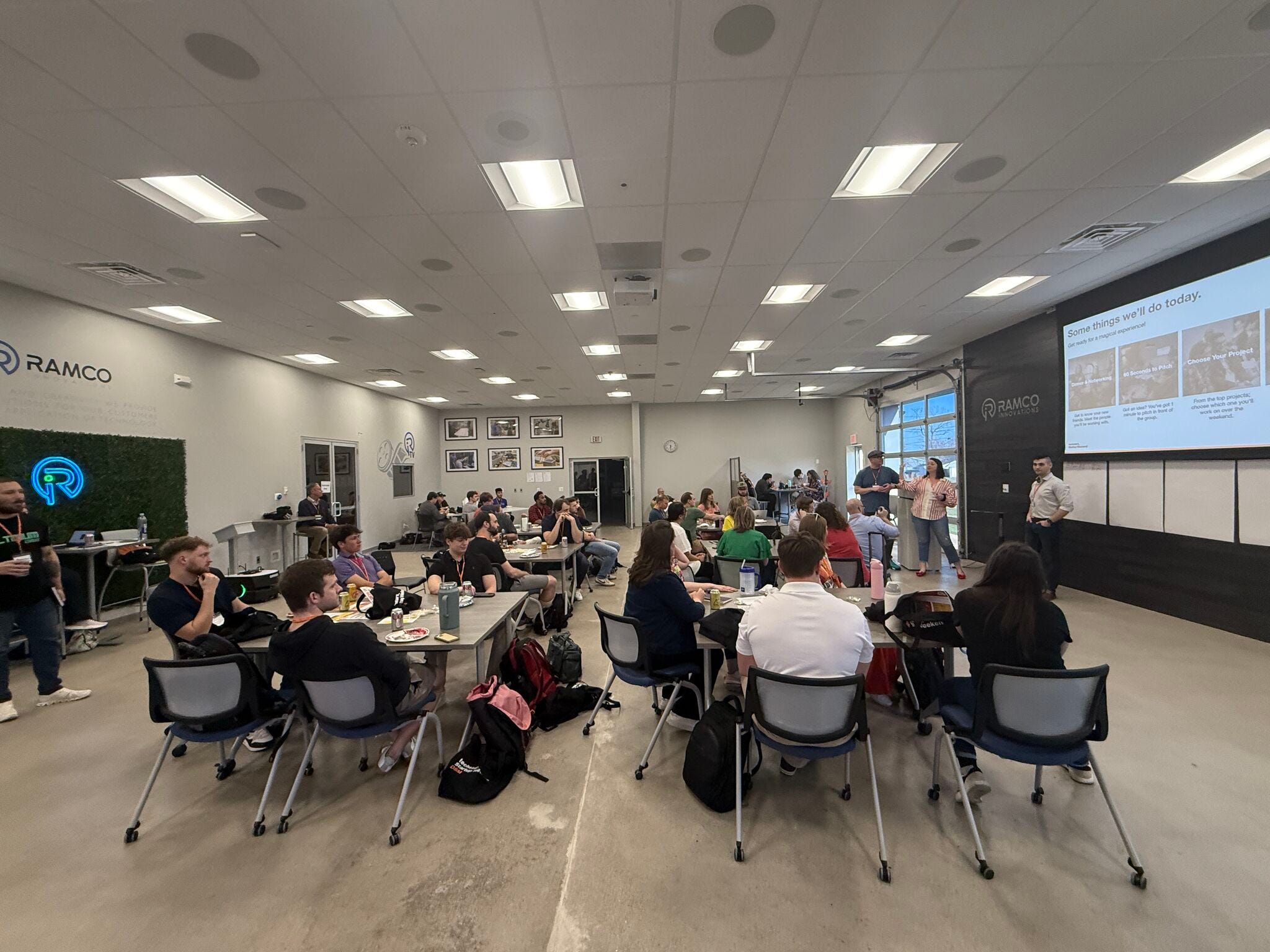
You bring your undeveloped ideas to the room. You’ve previously thought about this opportunity, perhaps experienced the problem first-hand. You might have doodled, inquired, and abandoned the idea over days, months or even years. Yet the pull of the event has brought you to try a different approach.
At the appointed time, as all are invited to pitch their idea to the gathering, you queue up alongside others. The most excited and nervous up front, the most tentative in the back even as others remain seated, absorbing courage from those already in line.
And you take the microphone, introduce yourself and, in 60 seconds tell the world about the problem you see, the opportunity you’ve identified, and invite others to join you in solving the problem.
In the remaining 54 hours.
Birds of a feather, flock together
Entrepreneurs and entrepreneurship-curious sign-up and show up on a Friday afternoon. Check-in is quick and intended to move attendees to their first social interaction - over food, of course. Casual dinner and networking end by 6 and everyone gathers in a one large space. Basic rules and logistics (restrooms, food, drink…) are shared and then the fun begins with an ice breaker as benign as a game of rock-paper-scissors.
Everyone is invited to pitch their idea to the room, but with a twist. Pitchers must introduce themselves, state the problem and potential solution in 60 seconds. They can ask for specific talent needed to complement their skills. ALL ideas are welcome and proudly displayed. Once all pitches are complete, all attendees are invited to “vote” on the listed ideas via simple stickers or tallies.


There is a method to the number of ideas selected to move forward and it depends upon the total number of attendees. Teams of 3-5 people generally do well but solo pitchers aren’t discouraged from working alone. Pitchers solicit members and this brief period is likely the most chaotic for the weekend. Hosts assign teams to workspaces that’ll be the team’s home for the weekend.
The Des Moines connection
Humans gather. Christened “Startup Weekend” in Boulder CO in 2008, this gathering was once a for-profit company. It, like the startups it would help create, had its missteps but quickly corrected course and by late 2009, friends and evangelists had morphed the idea into a non-profit and devised principles that remain true today.
Andrew Hyde, then CEO had a dilemma on his hands. The event was designed to build a single entity from the flurry of ideas and all attendees participated. They were paid back in pseudo-options for the entity created which was both cumbersome and not exactly loved by the SEC. On a chance pitch to improve Startup Weekend from Marc Nager and Clint Nelson, Andrew offered them the opportunity to run it.


Run it they did. For free. At their first event in San Francisco, they met Franck Nouyrigat who himself was building and raising for his iPhone app. Intoxicated by the energy of the event, he pivoted to help run Startup Weekend. The three began hosting these events and quickly realized a problem of scale - they couldn’t realize Startup Weekend’s global value without others. But they didn’t have money to pay themselves or hire people around the globe. It needed passionate volunteers.
The first of these passionate volunteers called them from the middle of America. Shane Reiser wanted to host an event in Des Moines, Iowa. Tweetups, a physical manifestation of the newly launched Twitter, had begun bringing people together, even in Des Moines. Des Moines’ budding entrepreneurs were talking about building companies but stopped short of taking the next step. He felt strongly that Startup Weekend would be a potential solution.


I owe a huge part of my entry to the Des Moines startup community to Shane Reiser as he welcomed me as a mentor to the Startup Weekend 2010 over coffee at Amici Coffee in downtown Des Moines.
Others shared Shane’s commitment and passion around the world and the network grew quickly. Des Moines’ earliest Startup Weekends gave rise to facilitators and mentors, many of whom remain engaged today. Andrew Kirpalani, Geoff Wood, Christian Renaud, Levi Rosol, Max Farrell and others who went on to create their own companies while helping others do the same.
The secret Startup Weekend sauce
In an age where it is increasingly easier to build companies, an old maxim from marketing professionals remains true. Young entrepreneurs (not in age, but time spent building companies) often jump into solving a problem they’ve encountered without understanding the market and opportunity. The consistently lowering cost of building a company exacerbates this problem, often leading to a premature ending of the pursuit and the company.
The first Startup Weekend activity, thus, involves understanding the problem from the target customer’s point of view. Teams engage with targeted customers to validate the problem statement, collect data about the size of the problem, pressure test the value to the customer (worth $0, $1, $10, $100?) and more.
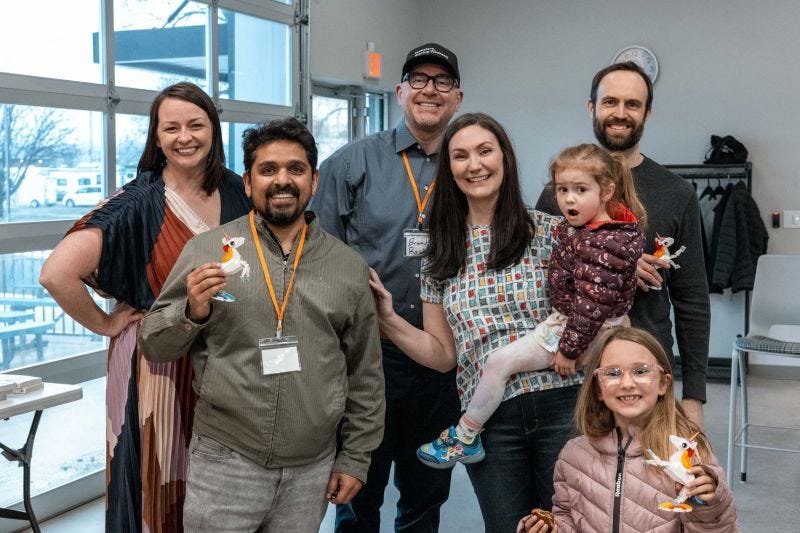
Some founders use surveys to solicit feedback. At the 2010 Startup Weekend, a founder building a website for local events went out to the Court Avenue district, blocks from the Startup Weekend venue, to solicit feedback from Friday night revelers. One founder at the recently concluded 2025 Startup Weekend engaged in deeper research in phone calls with her intended audience, some lasting as long as an hour to collect data and validate her hypothesis (her solution won first place!).
Because, without a top-line revenue plan, does one really have a business?
The Power of the community
Startup Weekends do not succeed without a surrounding community. Both the Boulder Thesis for successful startup communities AND the MIT REAP framework for entrepreneurial growth state that entrepreneurship succeeds in the hands of entrepreneurs. However, this success is fed by the critical role played by local governments, corporations, universities, risk capital and instigators.
Organizers have a multi-faceted task. Not only do they pull together a critical mass of entrepreneurs, but they also work hard to assemble their own risk capital - sponsors and funders. They assemble mentors who can guide the young (again, not age) entrepreneurs through the various steps of discovery. They assemble judges to help objectively pick a winner (more later). They organize sufficient food and drink, and pizza, caffeine and sugar remain critical throughout.
Mentor engagement is critical beginning Friday evening. The right mentors bring a mix of startup experience, market knowledge, inspiration, support, empathy and diplomacy. They also bring an innate ability to be able to say “I don’t know”.
Moving beyond Friday evening
Some Startup Weekends run continuously through the nights while others retire for rest. Some teams find that customer discovery pivots them away from their previously imagined solution. Others begin developing their product. Yet others realize that their team can only produce a set of slides and wireframes to refine their solution. And some realize the best next step is to abandon the idea - a perfect outcome for a commercial unviable product or service discovered with less than a weekend’s investment.
As Saturday bleeds into Sunday, mentors flow in and out of the weekend, guiding, and advising. They help refine the problem statement, the marketing approach, and financial models. Software engineers and designers mockup websites, mobile applications, and write code.
This is all in preparation for the upcoming mini-demo-day on Sunday afternoon. Energy waxes and wanes as final presentations are assembled, casual clothing and pajamas give way to presentation garb, and founders practice their pitches.
They’ll have 5 minutes this time to present their ideas.
Judging
The 2025 Startup Weekend came to a similar close on Sunday, March 30. 9 judges listened in on 11 pitches from teams who had traveled to Des Moines from as far as North Carolina. The youngest entrepreneur was a sophomore at Waukee High School with a fintech product and the remaining teams had members representing college students, professionally employed, self-employed, founders and investors.
Despite having served as a judge to nearly a dozen Startup Weekends, I have mixed emotions about judging these pitches. Startup Weekend is not about a win or loss. It isn’t about the best or the worst. And it certainly isn’t about who should or shouldn’t move forward. It is about the courage to pitch an idea to strangers, bare your soul to a team over 54 hours, spend blood, sweat (lots of it!) and tears (yup, these too), only to come to an end that comes too soon on Sunday afternoon.
Though there is a winner, a runner-up and a third place, and though there is a people’s choice awardee, I strongly feel that Startup Weekend’s biggest win is its ability to continually and magically pull disparate people together in pursuit of building anew.
The 2025 Des Moines event
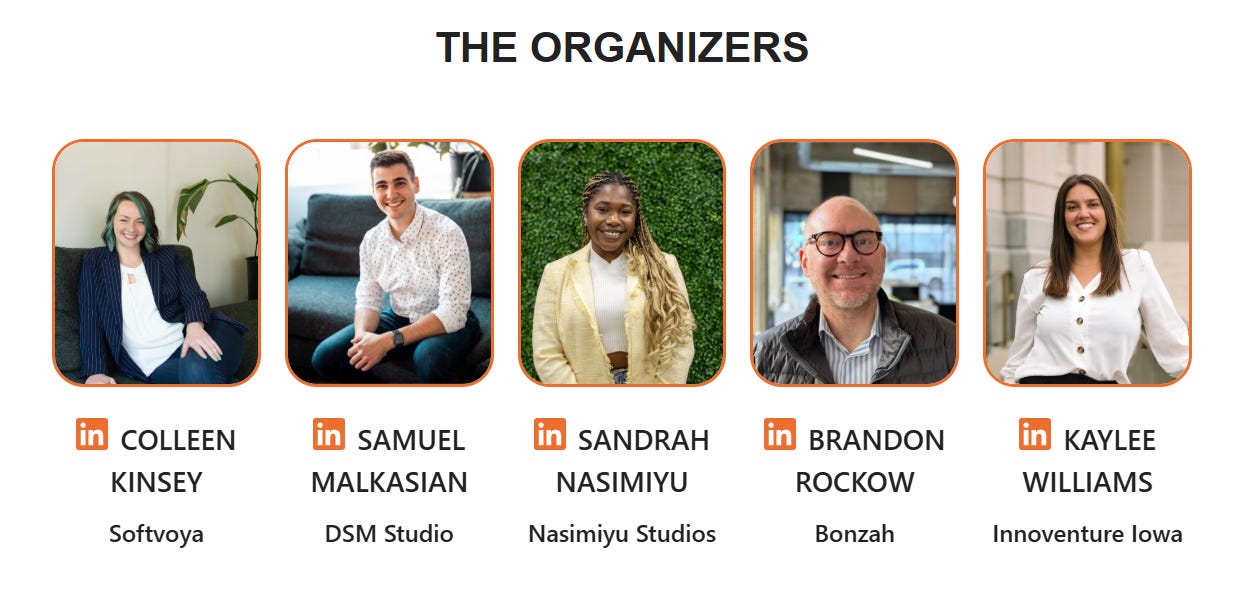
It takes commitment and courage to pull this together and this community is grateful for the work of Brandon Rockow, Colleen Kinsey and Samuel Malkasian. They revived this event here in 2024 during a massive snowstorm and built the 2025 event with strength and perseverance from the previous year’s experience.


A widening roster of sponsors and supporters of this event is encouraging as it reflects the community’s continued support. The presence of participant friends and families reflects the commitment necessary for an entrepreneur to succeed in any venture, especially one fraught with risk from its beginning.
I am glad for the event to have existed in 2008. I am grateful that Marc, Clint and Franck saw its potential and had the courage to change it. I am also grateful for Shane Reiser for bringing it to Des Moines and building a community to nurture it. And am in awe for Brandon, Colleen and Samuel for persevering.
Sources
Startup Weekend by Marc Nager, Franck Nouyrigat and Clint Nelson
Personal Participation and hosting
Photographs by Samuel, Brandon, Megan and Colleen
I am a proud member of the Iowa Startup Collective, a group of writers exploring entrepreneurship across Iowa. Click the link above to checkout my peers’ work
Found this old blog from when we did Startup Weekend Ames in 2015 (Geoff Wood, Sam Schill, and I): https://www.isupjcenter.org/2015/12/test-post/
All three winners have created companies that lived on from the weekend: Structurely, Farmland Finder (exited), and Nolan's Lawn + Landscape based in CR!
The events drive so much impact, even 10 years later...