
Email's walled garden
story of a startup that didn't make it

This story is different from the series so far in that it presents a failed startup.
Mine.
The startup was spared the life of a zombie company and may be useful to those building companies and finding themselves with a question on whether to continue.
Backstory
Startup founders embrace the adage that problems worth solving are those personal to them. As my kids were embracing technology during their late elementary school years, they wanted the means to electronically communicate with close friends and family. Cell phones were a few years from ubiquity in pre-teen hands and desktop applications and websites still ruled the world. Instagram was a photo sharing app and Snapchat etc. hadn’t yet found popular appeal.
I had prior experience with a system of whitelisted email whereby an end user could only exchange emails with a pre-authorized group of email addresses. This was a significantly limited use of the world in which emails flow freely between senders and recipients with little security or control.
A thought emerged to morph the concept for emails for children.
Children’s Online Privacy
There is a federal rule that governs the privacy of children under 13 years old. The Children’s Online Personal Privacy Act, COPPA, prohibits website operators from collecting personal information from children and requires verifiable parental consent prior to engaging children under 13 on their platforms.
To create an email platform, we minimally needed a person’s name, desired email address, names and emails of people they were allowed to communicate with, and a means to bill for the service. Many of these are personally identifiable attributes, thus subject to COPPA’s oversight.
Collaborators
I reached out to two colleagues who had experience with whitelisted email and were exploring their own ideas for a startup. As Erin Rollenhagen, Joe Vande Kieft and I reviewed COPPA and thought about solving this problem, we arrived at creating a system where we’d create a customer relationship with parents interested in providing their children with these communications means. We went from collaborators to co-founders quite quickly.
Erin and Joe are technology wizards. They’d worked around thorny technology problems before, and this was a white-board-able problem.
We thought about solving the age verification problem and quickly dismissed the idea of asking parents for their driver’s license or other government IDs to avoid the liability of storing personal information. Years away from the KYC (know your customer) verification methods of today, we ended up relying, instead, on verification through a credit card charge. Knowing this would be a significant barrier to customer acquisition it was, at the time, a straightforward way to remain compliant.
Fighting Freemium
I had come of age in the technology industry in the late 1980s and early 1990s when indie developers often released their software as ‘shareware’. Their software was freely copyable and transferable to others so a large number of people could experience and evaluate it for their own use. Often limited in some way – time-bombed for a period, limited features, or released as a trial version upgradable to a paid full-feature set. Shareware was distributed via dial-up bulletin board services, government run file transfer sites (e.g. the Army’s SIMTEL) or companies such as PCSIG (PC-SIG Diskette Library) that mailed diskettes for a small fee.
With the advent of the world wide web and wider adoption of consumer Internet beginning in the mid-1990s, trial software moved to the free Internet sites. Some software naturally gravitated to browser-based applications while others remained desktop-based but distributed directly by the programmers. Some programmers simply wanted to share their programming for free, a feeling that persists in many open-source projects today. Others searched for quick ways to convert inquisitive prospects to paying customers.
Despite ample guidance to the contrary and working with the COPPA compliance constraint, we took the road (much) less travelled and decided to charge upfront.
Customer Discovery
We performed customer discovery to understand if the problem I’d encountered had broad appeal. Yet we made a few critical errors, loosely classified into three areas:
Dads didn’t care: every father we spoke with about providing children a whitelisted email service told us that they’d continue setting up free email accounts for their kids and simply monitor all email. They were largely unconcerned about undesirable messages making into their kids’ mailboxes.
Confirmation bias: I reached out, first, to friends and networks closest to me, ignoring the fact that those closest to me probably thought like me and were likely to agree with my hypothesis that parents wanted a walled garden around their kids’ electronic communication.
Incorrect Assumptions: We made assumptions that population segments who cared deeply about what their children were consuming online would be extra sensitive to and welcome our product. We specifically targeted communities such as home-schooling parents and promoted our service at relevant conferences.
We had data but didn’t listen to it close enough.
The product
Pikuzone launched in 2011 as a website that welcomed parents and explained its premise. Parents were provided a no-questions, money back guarantee when setting up an account which entailed:
Parents could setup an unlimited number of email addresses for their children
Parents could add an unlimited number of email addresses for authorized emails (such as friends, grandparents, other family) and map them to the children
Parents could choose to monitor in/out bound emails
Parents could cancel their account within 30 days for a full refund
Parents could cancel their accounts at any time with a prorated refund of services
We tapped into a growing interest in Japanese-sounding names when naming the service Pikuzone. It tested well with children and wasn’t hard to spell. It didn’t appear to carry baggage in other languages.
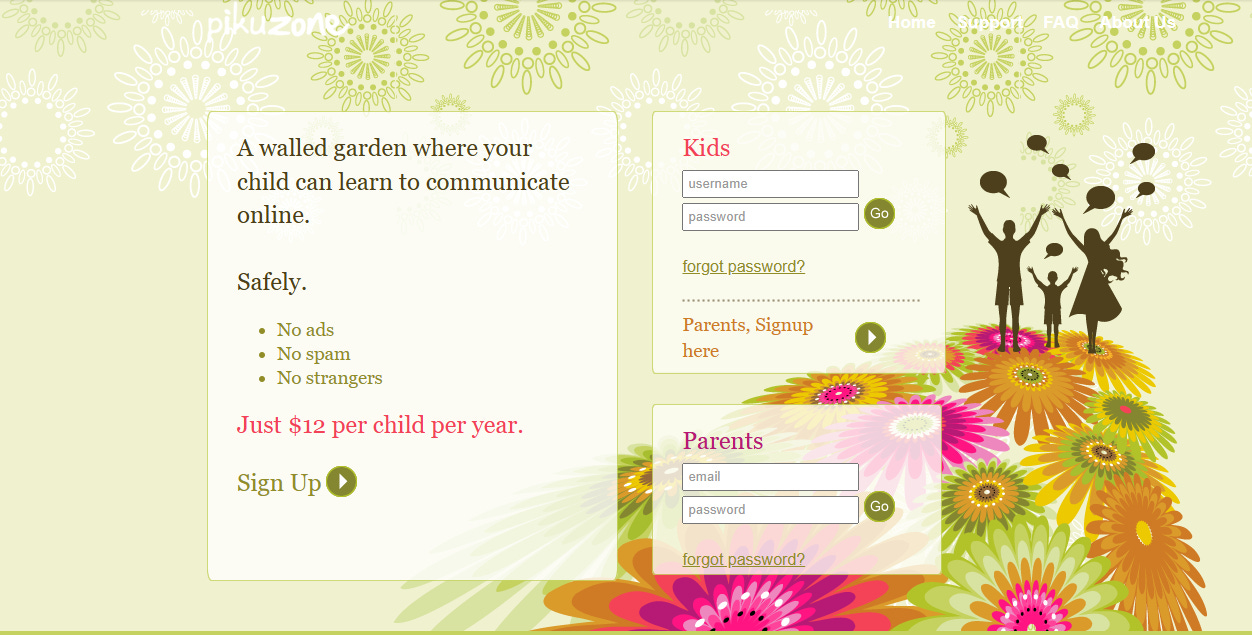
We marketed it via personal networks, home school conferences, via Facebook ads and Google Adwords. The only human sales approaches were at the conferences and by the founding team’s own networking.
Traction
Traction was slow at first but approached nearly 1,800 paying customers in the first 12 months. Customer feedback remained strong, with parents writing in appreciation to us and some recommending the product to their networks.
Rubber meets the road
Early traction led us to review what was working and what wasn’t. We had not raised outside capital, choosing instead to finance all operations through our own funds, sweat equity, and community goodwill. We were able to manage expenses, perform all software engineering in-house, pay the bills via our operational income and run the business almost as a passive entity. Yet a question continually bugged us from within:
Why was the system not resonating with more people?
We recognized two social forces simultaneously at work against our product:
Standalone devices such as Circle introduced web/app filtering on home networks and ended up in a partnership with a global kid-friendly brand. Though it was ultimately destroyed by the corporate acquisition, parents bought it to protect the home network through controls, thinking it would be all-encompassing.
Children themselves began moving to new social media networks including Instagram and Snapchat. Though required to comply with COPPA, social networks appeared to turn a blind eye to COPPA’s age limits. The network effect of these unrestricted applications made walled gardens such as ours unpalatable for pre-teens hungry for private conversation.
The Final Epiphany
We decided to run an experiment when tweaking our Adwords one afternoon. We began closely reviewing each subscribing parent on LinkedIn, searching for common attributes. A pattern quickly emerged telling us that a significant number of subscribers were:
Women
who appeared to have advanced degrees
were professionally employed
who appeared to be from blue (liberal) states (President Obama’s 1st term)
who had titles that reflected higher than median incomes
None of these had been our selection criteria when selecting targeted advertising words. Using the newly released Facebook advertising tool, we attempted to create a profile that closely matched our discovery. The tool, with each new criterion, progressively computed the size of potential audience we could target.
We played with variables not visible on LinkedIn such as likely homeownership, likely marital status, single or dual-income household and others. Within minutes we had a disturbing number facing us on the Facebook ad manager:
Audience size: 33,000
We had just found that our potential audience (the serviceable market) amongst Facebook members was fewer than 33,000 subscribers. At our $12/child/year subscription, that translated to an expected maximum annual revenue of $396,000 if we could convert 100% of the audience.
The sobering reality
What we had built and nurtured over the past year was doing a world of good but would not be a commercially viable success. It was loved by its users but would only survive as a zombie startup, one that stayed alive due to pride, founders’ passion, and a viable utility to a small population. No financial windfall for its founders.
It needed to be euthanized.
We came to the quick decision to shutter the company that very afternoon. The only job remaining was to fulfill the original promise of a guarantee. We had sufficient funds to refund pro-rated monies but made the difficult yet necessary decision to refund the entire purchase price as we were choosing to shutter.
We wrote a statement to all subscribers letting them know that we would refund their entire credit card charge, delete the emails sent/received at the end of the month, and were grateful to them for placing their families’ trust in us. We didn’t, in good conscience, want to prolong an unsustainable startup.
Pikuzone ended its life as a startup in 2013.
Why tell this story
Not all startups succeed. Sometimes the original hypotheses are proven incorrect. Sometimes the business models are flawed. Sometimes regulation gets in the way. Sometimes worthier competitors displace well regarded ideas. Sometimes winds simply blow in opposing directions. Culture has an insatiable appetite for strategy.
The founding teams have to make a choice – persist or blow with the winds of change. Zombie companies that choose to persist while facing unwinnable forces rob communities of valuable resources – people, money, and passion. Pivoting away from a company or an idea is the alternative - an acceptable outcome for startups. The world needs successful ideas to build upon the compost heap of unsuccessful ones.
A startup’s end isn’t a funeral but a celebration of the founders who attempted an idea, took a risk, committed time and energy, tested their hypotheses, accepted failure, chose to face the inevitable and moved on courageously and swiftly.
Pikuzone was one of the nine companies in the StartupCity portfolio with subscribers in over a dozen states. As this Substack chronicles the stories of Iowa technology companies, it remains important to discuss what worked, what didn’t, and what lessons persist for the advantage of future founders. In that spirit of lessons learned, an original motivation of StartupCity Des Moines lives on.
I am a proud member of the Iowa Writers Collaborative and the Iowa Startup Collective. Each writer is independent and publishes via Substack across Iowa.
Not all startups continue. Not all initiatives play out. Not all jobs are meant to be forever. But does that mean we fail? Or that we are learning and iterating? Thanks for sharing!
Thanks for this fascinating story. So much to learn from you!