
Accelerating Entrepreneurship - Part I
The Global Insurance Accelerator

I intend to spend at least three December weeks documenting influential entrepreneurial organizations across Iowa. We will dig into the Des Moines-based Global Insurance Accelerator, now a nearly twelve-year-old institution continuing to lead in insurance innovation. We will fly across to New Bohemian Collaborative in Cedar Rapids, which has proven its entrepreneurial mettle by regularly reinventing itself to meet the changing demands of its entrepreneurial community. And we will look back at the three-year experiment that was Startup City Des Moines (SCDSM). The three demonstrate a propensity for investment, share a bit of the why behind the investments, and the lessons they continue to impart.
I recognize the numerous other new and experienced organizations focused on parallel efforts and promise to revisit them in subsequent months. Let us open December with the Global Insurance Accelerator. As with any memoir, everything until the section titled “v2.0” is my memory and could be inconsistent with others’. I invite those with additional facts or corrections to please place them in the comments for the benefit of history.
The story, like many technologies, is separated into three cycles led by three different managing directors. Although the program appears similar from the outside, the three cycles have achieved distinct stages of maturity. Consistent with the approach to versioning technology releases, we begin with the beta.
The Beta launch
Can something come before birth? Conception, of course :). Though more reasons for conception will become clearer in the Startup City chapter, the origins of this accelerator go back to late 2013 when Christian Renaud and I were capturing and documenting our goings-on at SCDSM and publicly sharing them on a quarterly cadence. One reflection I shared was an acknowledgement of a growing trend of accelerators and how the region could benefit from a vertically-focused accelerator which tapped into the inherent strengths of our community. Christian, simultaneously, reflected upon and researched a concept to tap into the region’s visible biotechnology ecosystem. We explored concepts for financial services (fintech), insurance (insurtech) and biotechnology (biotech). Those reflections, papers and designs provided great fodder for academic discussions and explorations (such as walking through defunct theaters on 5th and Locust in Des Moines to imagine them as impossibly expensive wet labs for biotech research in the downtown core).
Jay Byers, then CEO of the Greater Des Moines Partnership (GDMP), asked if he could keep a copy of the two-page vertically-focused accelerator. I agreed. He would resurrect it about six months later as we shared a beverage on court avenue and ask if it still held interest as he had an idea to explore. He proposed we convert the proposal into a short deck and discuss it with as many insurance company CEOs as possible to obtain feedback and offered to open as many doors as his position could influence. Mike Colwell, then leading the entrepreneurial initiatives for the GDMP, took charge on the deck and prepared a short deck consistent with Guy Kawasaki’s template from the Art of the Start.
Accelerator research
Jay went about opening doors to nearly 81 insurance CEO offices from the nearly 400 companies conducting insurance business across Iowa. Just as he made his phone calls, Mike and I began talking to accelerator programs about logistics, lessons learned, best practices, costs and mentorship. We received wonderful guidance from the industry behemoth, Techstars and adopted its mentor manifesto nearly verbatim.
We also studied recently retired accelerators. Accelerators led by Sprint, Nike and Disney were three such retirees sponsored by a single corporate entity. We learned about non-profit accelerators and how profit-focused startups needed a profit-focused environment and mindset. We also learned of the cardinal sin - that an accelerator with a single-minded focus on raising money from investors didn’t lead the startups in its care toward sustainable profitability.
We also learned that the financial models behind successful accelerators had a multi-year commitment for capital, with the most successful ones seeking commitments of $5-$11 million before getting started. Knowing that such multiple millions was practically impossible in Iowa, a bespoke financial model was developed from scratch.
v1.0 - April 2014
Jay had us ask Larry Zimpleman, CEO of Principal Financial Group, for the first meeting. Anticipating a two to three month wait to secure time on a Fortune 500 CEO’s calendar, we thought we’d have ample time to plan. Larry’s office offered us a slot the very next afternoon. He met us with Principal’s CIO, Gary Scholten, and listened patiently to the deck. Then, in incredible prescience and commitment, promised the entire ask, $100,000 per year for three years with a condition that the board would be formed as a group of equals with Principal having an equal position on the investor board. Shortly thereafter, Principal appointed Doug Fick, CIO for its US Life and Benefits business as the board representative.
Naturally, this commitment lent substantial wind to the sails and we proceeded to the next meeting with Jeff Russell, the CEO for Delta Dental of Iowa. Jeff, no stranger to innovation in insurance AND financial services welcomed Principal’s condition, saw the value for the proposed accelerator and secured Delta Dental’s support. He also volunteered to serve as a candidate to the accelerator’s board of directors.
The accelerator fully launched soon with critical support from five other leaders - Grinnell Mutual Reinsurance Company, Farmers Mutual Hail Insurance, IMT Insurance, Farm Bureau Financial Services and American Equity Investment Life Insurance Company.
Structure
We had proposed and planned a financial model comprising a minimum of 7 insurance companies as investors, each committing to investing $100,000 annually. We planned a $50,000 investment in up to 7 startups annually leaving $350,000 for operating the accelerator. Our three-year budget approximated $2,100,000 and was considerably lower than suggested by research. Yet it appeared achievable and we persisted.
We also planned a single managing director to start - an individual who was an entrepreneur with history of mentoring, guiding, building and a belief in the mentor manifesto. Knowing such a unicorn would be hard to find, I began serving as an interim MD as we initiated a nationwide search for both the best person to lead the accelerator and startups to form its inaugural class.
Inaugural Managing Director
The MD for an accelerator is the glue that binds startups, mentors, investors, community members, media, onlookers and peer accelerators, thus requiring an experienced juggler. In the accelerator’s formative years, the juggler needed to be especially skilled with a dose of humility, ingenuity, energy and likeability to transcend the varied audiences. The search netted us several candidates from across the country, but each applicant fell short on multiple criteria.
We were at a frustrating end to our search where we simply hadn’t located any individual meeting all our unicorn criteria. As we discussed restarting the search over coffee at Friedrichs Coffee in Urbandale, Jeff asked if we had performed any outreach to individuals we knew to be qualified even if they weren’t in the market. We thought of one who surely wasn’t in the market but at Jeff’s insistence decided to probe his interest.
Mike made the call and, much to our collective surprise, Brian Hemesath was dreaming about such a challenge. He quickly rose as the candidate we sought and and assumed his role in Nov 2014 as the Global Insurance Accelerator’s first managing director. I transitioned to an independent director role, joining Sheldon Ohringer as the second independent director to the GIA’s board of directors. The team continued searching for the accelerator’s inaugural class.
Inaugural Class
The program was designed as a 100-day intensive to conclude with a demo/pitch day at the Global Insurance Symposium (GIS) in Des Moines. Backtracking from the pre-set date for the GIS, the start date for the accelerator fell to mid-January. Bringing startups from around the world to snowy, icy Iowa for a 100-day program became a running joke, one that would prove fruitful toward a truly immersive program.
Although several online communities served as directories for new startups, the first applicant was a referral from Craig Ibsen of Next Level Ventures. Three ISU engineering students Morgan Hampel, Tyler Fox and Justin Coaldrake pitched the idea for an electronic health record for speech pathologists. Several others followed soon thereafter via portals, referrals and direct outreach.
Despite early resistance to inclusion of Clinicnote, the speech pathology EMR into the accelerator, Clinicnote, the first pitch became the last entrant to the 2015 cohort and remains a viable company today. Pablow, a startup run by two brothers - one in Australia and another in Germany traveled the furthest and remains a part of the Iowa entrepreneurial ecosystem today.
Board
We underestimated the power of the accelerator’s board of directors for its future. The governing board quickly transformed into a powerful glue through its expertise and industry networks. Consisting of the two independent directors named earlier and a representative from each of the seven insurers who funded the accelerator, it received input and attention from a diverse set of industry voices. Most investors appointed a deputy to the board and to each team’s credit, the primary and deputy often attended the board meetings, creating a natural transition and succession plan.
The board also became the initial mentors along with several industry voices they solicited to develop into mentors. Through Brian’s leadership, the mentors brought insight, experience, connections and minefields to avoid.
The board also took several actions in that inaugural year under Jeff’s leadership, actions that had palpable effects in Des Moines and on insurance hubs around the world. The board audaciously decided to call itself the “Global Insurance Accelerator” and not simply an Insurance Accelerator or a Insurtech accelerator and begin a practice of finding and inviting startups from around the world.
Contrart to most accelerator programs, the board worked to emphasize the importance of a positive income statement during the program. This direction to income statement from a balance sheet shifted focus for the startups on generating revenue early from real customers rather than just an ability to raise money.
But the most impactful foundation laid by the board, one quite revolutionary at the time, was for competitors and unrelated insurers to come together as a team of equals around a shared purpose and identity. They welcomed and adopted an antitrust statement while simultaneously remaining a collaborative. They represented life insurance, employee benefits, reinsurance, ag insurance, property and casualty, and dental insurance.
Demo Day 2015
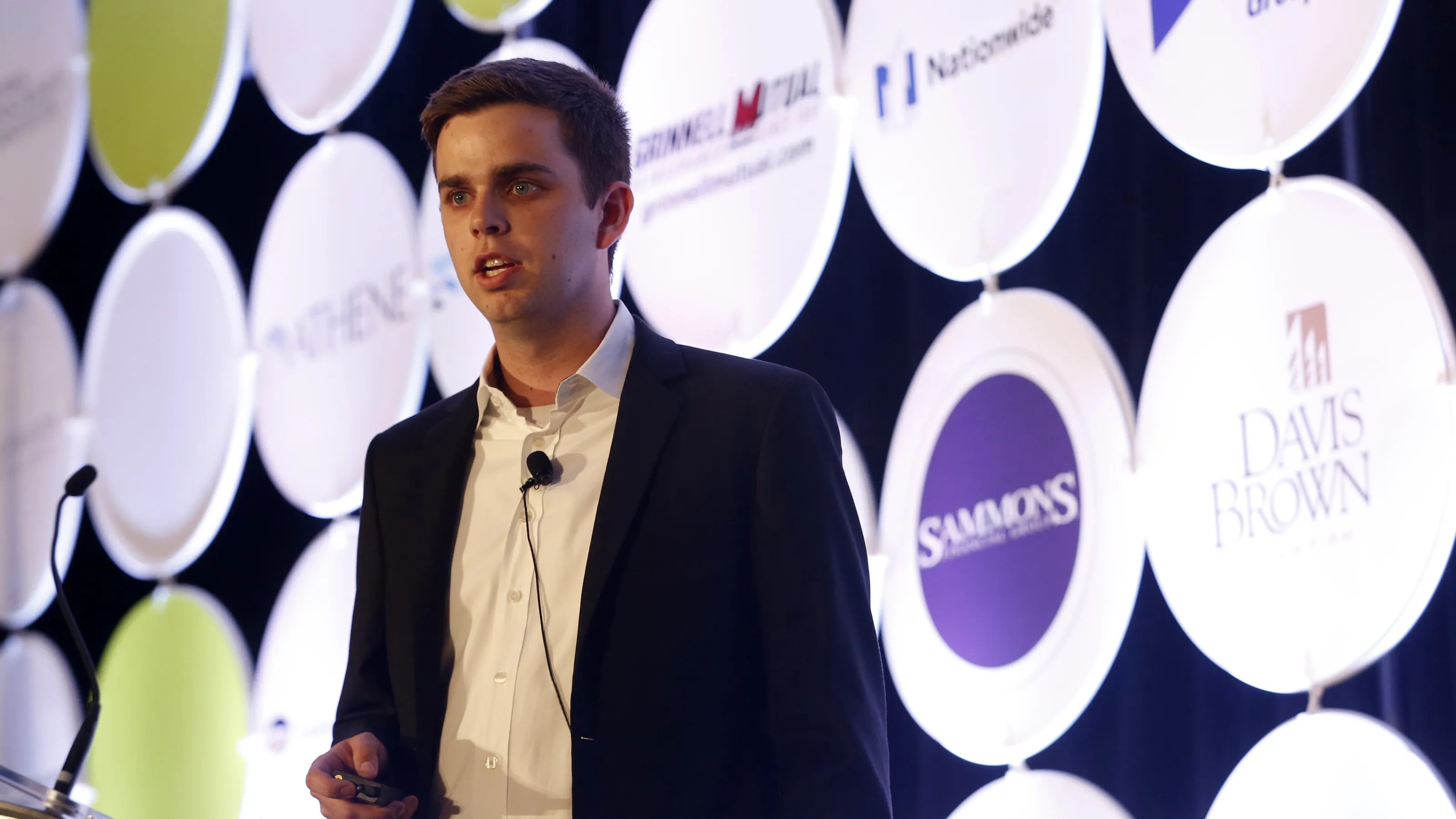
The inaugural class graduated in April 2015 at the annual global insurance symposium, held then at the downtown Marriott. Teams presented the companies they were building, one after another to a broad audience of industry representatives. Even a wayward fire alarm couldn’t stall the momentum that had been created just a few short months prior. The GIA had placed itself in the center of all things innovation in the insurance industry.
Branching and Growing
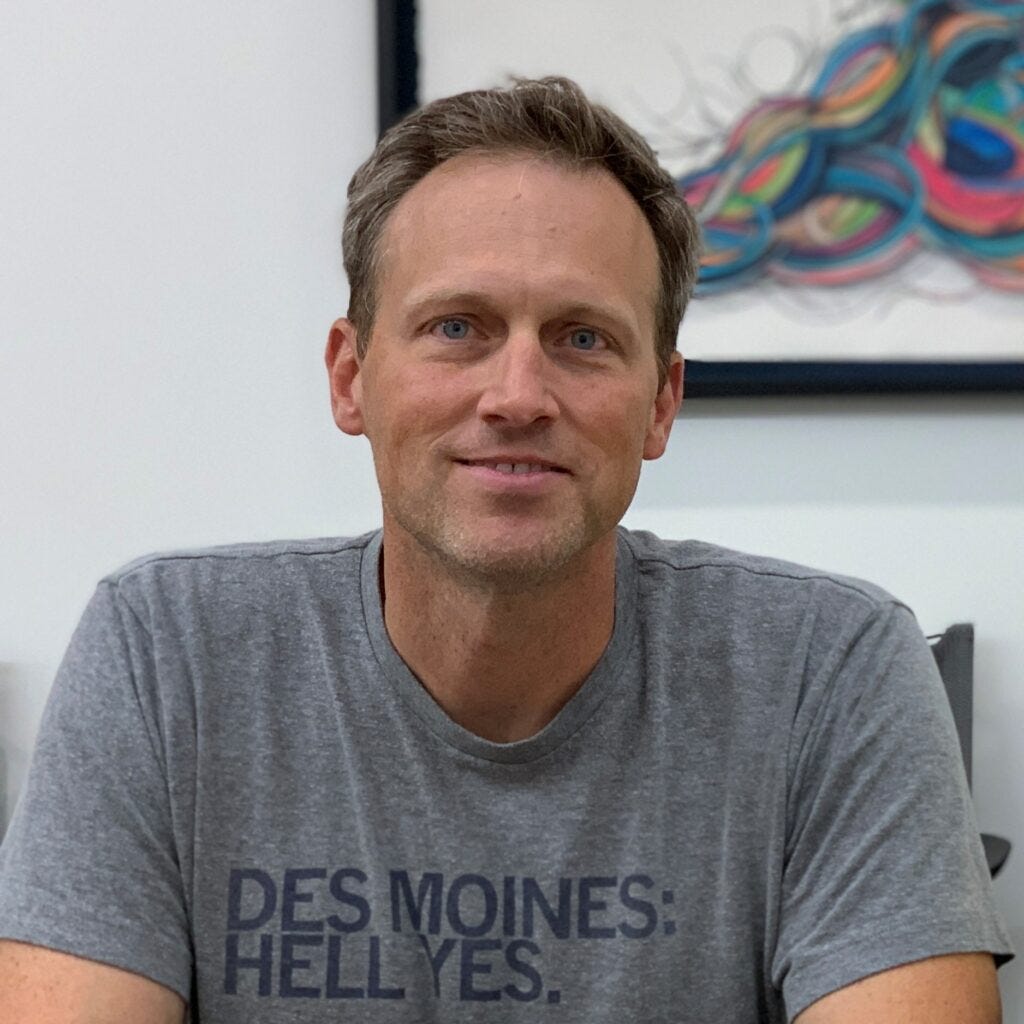
Unwilling to rest on the laurels from its first year’s success, the GIA began expanding its approach and reach. Brian and board members expanded to industry conferences and spoke about their experiences. ACORD, Insurtech Connect and others provided audiences receptive to and surprised at the collaboration. Although Des Moines’ role in global insurance was known, Brian’s memorable uniform - a Raygun shirt with the slightly irreverent slogan - Des Moines, Hell Yes - put it front and center.
Brian also recognized the growing influence of mentors, a need to carefully invite, welcome, vet, nurture and continually curate the accelerator’s primary asset for the startups. He designed the job description for and onboarded Megan Brandt to begin serving as the accelerator’s program manager where she formalized the mentor program and became a constant presence for subsequent classes.
The roster of investors and board members waxed and waned with time, and Brian led five classes of startups, eventually transitioning back to his entrepreneurial venture, Volunteerlocal in April 2019.
v2.0 - 2018
As the accelerator changed and grew, so did the needs from his chief executive. Four cohorts had expanded the accelerator’s financial footprint, its portfolio of investments in the startups, requests for alternative terms for the accelerator’s investments from prospective members and more. Brian’s replacement, thus, couldn’t be a simple replacement, rather one who filled the changing needs of the job.
I had transitioned away from the board by this time and found the board’s selection of Nicole Cook Gunderson significant. She brought an investment professional’s perspective to the role of the managing director. Brian’s foundational work had taken the training wheels off the accelerator and Nicole could now add growth fuel. To her credit, she maintained Megan’s role and remit in this next stage.


v3.0 - 2022
Another transition was in the works by 2022 as Nicole began a transition full-time to venture capital. ManchesterStory, a Des Moines-based venture capital firm focused on investing in insurance, financial services and health focused startups became her new home for role as Principal. Megan Brandt was also considering a career change and found an opportunity at Maple Studios, a West Des Moines-based hardware and engineering services coworking space and incubator.
Dan Israel, Principal’s relationship manager to the GIA found the opportunity intriguing and became the leading candidate for the accelerator’s third MD. He joined shortly after Nicole’s transition and continued the evolution of accelerator to its hybrid program state, opening up its approach and prospects to more global organizations. The accelerator also continued to attract attention of more mature Insurtech companies who complemented startups equally eager to innovate in the industry. Megan’s role was filled by Jess Louis to continue curating the mentor program, modifying and selecting program resources, and operating the accelerator’s daily activities. With eight cohort of startups with varying fundraising events, executive transitions, product matrices and more, another role became apparent, and Jenny Gruenisen rounded out the team as the alumni director in stewardship of the portfolio.


A Decade of Success
The inaugural board had learned from the lessons of Nike, Disney and Sprint accelerators and diversified its investors across multiple insurance segments. Though some investors withdrew as others joined, the accelerator continued operating through an uncertain decade in the startup, investing and insurance industry.
The period saw a global pandemic disrupt supply chains and thus replacement costs for roofs, cars, and building materials. It saw a rise and fall of early-stage investment capital in the startup community with rise and fall in financial markets. The period experienced impacts of climate change wreak havoc on the home and auto insurance markets in coastal regions through hurricanes and floods, and on home, crop, auto and flood insurance in the Midwest through catastrophic storms, tornadoes and hail.
Rather than reiterate the recent history, I’ll link to the GIA’s tenth anniversary report below as it provides a comprehensive lookback on its people and their pursuit of innovations in insurance, a necessary component of our life in modern society. The GIA’s superpower remains its cross-industry leadership, investment, prescience and constant innovation.

Closing thoughts
Our insurance footprint and investment aren’t happenstance. The expertise in building great insurance companies extends back into the city’s history for over a hundred years and complex support networks built across academia to government over that period. Drake University, ISU and Iowa provide leading programs in actuarial science, preparing students from as far as Malaysia to lead changes in insurance.
Government and Economic Development strategies to continually bolster this leadership in insurance is similarly multi-decade story of investment. The Iowa Insurance Division, under commissioner Doug Ommen’s leadership, is visibly open to collaboration with established insurers and startups, his and his team’s commitments evident in active participation with the GIA and entrepreneurship-focused events. The Global Insurance Symposium began well in advance of the GIA’s formation and provided a global stage for the first cohort. Governor Vilsack even brokered a commitment and relationship between innovation and insurance in 2001, swapping a premium discount for a tax credit. Several insurers continue to honor that commitment, investing in accelerators, venture funds, internal and external innovation.
It is easy to take the GIA organization, its investments in insurance innovation, and its ability to draw entrepreneurs from many corners of the world for granted. Doing so, however, is done at our own peril because just like the startups in its ever-changing cohort of classes, the GIA also requires continual attention and refresh, especially as well-funded organizations near and far attempt to copy and better our playbook.
After all, in the words of Intel’s late CEO Andy Grove, only the paranoid survive.
This definitely feels like an "only in Iowa" tale. I'll always remember the meeting in Larry Zimpleman's office to hear about the GIA vision and the follow-up conversation that Larry and I had about it. And now it's such a success story!
"Jay went about opening doors to nearly 81 insurance CEO offices from the nearly 400 companies conducting insurance business across Iowa."
What a legacy. Jay was always the first believer. It's something special to see a CEO take the time to create 81 warm intros for a new idea on a startup for startups!